
Ultimate Japan Travel Guide | Free Itinerary & Planning Tips
Planning a Trip to Japan? Start Here.
If you’ve ever typed “how to plan a trip to Japan” into Google, you’ve probably felt overwhelmed.
You’re not alone.
Between TikToks, blogs, Reddit posts, and outdated info, planning your Japan adventure can feel like a full-time job.
That’s exactly why I created my free Japan travel guide.
Whether you’re going for 10, 15 or 20 days, solo or with your family, this guide helps you plan smart, travel stress-free, and enjoy every moment.
1. Not Sure Where to Start?
I've create a Step-by-step guide here.
#1 General informations
Capital : Tokyo
Language: Japanese
Money : Yen JPY
Driving in Japan : Left-handed
Telephone code : +81
Peace index : 9/ 163 countries
Cost of living : https://www.numbeo.com/cost-of-living/in/Tokyo
#2 Seasons & when to go
Spring: Pleasant temperatures and cherry blossoms in April and May make it peak tourist season, despite crowds at festivals like Takayama Spring Festival.
Summer: High temperatures and regular rains, ideal for climbing Mount Fuji and attending cultural events (matsuri)
Autumn: Optimal weather with mild temperatures and vibrant foliage known as koyo marks the end of peak tourist season.
Winter: Perfect for skiing in places like Saharo, Furano, and Rusutsu, and experiencing Japan under snow, along with hot springs (onsen) and year-end festivities.
#3 Security Health & Other
Respect for customs and etiquette is important in Japan. Learn basic Japanese manners, such as bowing, removing shoes indoors, and proper chopstick etiquette.
Japan is considered one of the safest countries in the world for travelers. However, exercise common sense and take precaution.
Healthcare standards in Japan are high, but medical expenses can be costly for foreigners. Consider purchasing travel insurance that includes medical coverage before your trip.
Tipping is not customary in Japan and may even be considered rude. Exceptional service is often included in the price or acknowledged with a polite thank you. That said, you can tip if you want. They'll maybe refuse or be suprised.
#4 Cities to not miss
The Golden road : Kyoto, Osaka, Hiroshima & Tokyo ! The basic, touristy, "must-see" road.
HOW to plan your trip step-by-step
START WITH WHEN : Pick your dates (and season)
🍁 Autumn (Sep–Nov): foliage, calm, ideal weather
❄️ Winter (Dec–Feb): snow, onsen, cold
🌸 Spring (Mar–May): cherry blossoms, festivals, big crowds
🔥 Summer (Jun–Aug): hot, vibrant, fireworks, typhoons
BUILT YOUR ITINERARY : 1. Choose your base cities
Known as golden route
TOKYO
Capital. Must-visit. Each neighborhood feels like a new city. Non-stop trains, anime, museums, food at 2 AM.
Temples, nature, red torii gates, golden pavilion. Slower pace mood.
OSAKA
USJ, Dotonbori, street food. Chill locals, loud energy.
HIROSHIMA
Peace Memorial, Atomic Dome, moving museum. Ferry to Miyajima for the giant floating torii and island views.
Other popular places
KOBE
Port city. Famous beef, ropeways, sake breweries, and a compact Chinatown. Feels global, not touristy.
NARA
Day trip from Kyoto/Osaka. Deer everywhere. Huge Buddha inside Japan’s oldest wooden temple.
OKINAWA
Tropical islands. Crystal-clear beaches, taco rice, WWII history. Very different vibe from mainland Japan.
TAKAYAMA & KANAZAWA
Old towns, samurai streets, morning markets. Takayama = mountains. Kanazawa = art, gold, geisha district.
FUJIKAWAGUCHIKO, FUJIYOSHIDA
Best Fuji views. Lake life + theme park.
HAKONE
Close to Tokyo. Onsen town, lake cruises, open-air museum, Mt Fuji views on a clear day. Classic weekend escape.
Popular but less visited (when first time)
KYUSHU
Hot springs, volcanoes, and underrated cities. Fukuoka = ramen & culture. Beppu = onsen hells. Nagasaki = history, fusion vibes. Great for slower, scenic travel.
SHIKOKU
Least touristy main island. Pilgrimage route (88 temples), hidden gorges, traditional bridges, udon in Kagawa. Peaceful, rural, super local.
HOKKAIDO
North = wild nature. Snow festivals, ski resorts (Niseko), lavender fields in summer. Sapporo = beer + ramen. Big landscapes, fewer crowds.
2.BUILT YOUR ITINERARY :
Sample Itinerary for first-timers
🗓️ 15-Day Itinerary
• Tokyo – 5 days
• Fujikawaguchiko & Fujiyoshida – 1 day
• Kyoto – 4 days
↳ Includes day trip to Nara or Uji
• Osaka – 2 days
• Japanese alp or Hiroshima– 2 days
• Back to Tokyo – 1 day
🗓️ 20-Day Itinerary
• Tokyo – 5 days
• Fujikawaguchiko – 1 day
• Kanazawa – 2 days
• Takayama – 2 days
• Kyoto – 4 days
↳ Includes day trip to Nara or Uji
• Osaka – 3 days
↳ Includes day trip to Himeji or Kobe
• Hiroshima – 2 days
• Back to Tokyo – 1 day
You don’t need to visit 10 cities. But I also get it : this might be the trip of your life. Some people save up for years. So here's the rule : Do what you want to do and what you’re able to do. The key is that your trip feels like you.
3. BUILT YOUR ITINERARY :
Build a smart itinerary & daily plan
📝 List everything you want to see
Make a list of everything you want to see, the best is to pin them on a map like google map. (You can use mine : link in caption.) This way you can visualize.
📍 Group them by area (wards/districts) to build daily plan
Stick to 2 o 3 district max, that not far from each other, per day = less time in transit, more time exploring.
You can use : Holicay
📅 Double-check open days
Especially for museums, gardens, and themed cafés some close midweek.
🛏️ Add buffer time
Unless you love rushing, plan chill breaks to actually enjoy your trip & chill, getting lost in the city.
Your trip doesn’t need to be packed from 7AM to midnight. (Except if you love THAT of course)
🚫 You don’t have to “do it all”
💡 A good plan = balance between activity & space to enjoy
Leave time to explore, rest, wander : those spontaneous moments are the best.
HOW TO FIND THE BEST ACTIVITIES
GET YOUR GUIDE
One of the easiest ways to find the best activities in Japan is through GetYourGuide. You can filter by city, see real traveler reviews, and book instantly, from food tours to day trips and cultural experiences.
I’ve also collected my favorite activities in Japan in one place, so you don’t have to search for hours. You’ll find them all here
DISCOUNT CODE : TABIMAWARI5
Popular in Asia for activities, transport passes, and tickets.
Wabunka is an online platform dedicated to offering exclusive, private tours and expert-led experiences that immerse travelers in Japan's rich cultural heritage. From guided visits to UNESCO World Heritage sites to hands-on workshops with master artisans, Wabunka provides a curated selection of activities designed to offer authentic insights into Japanese traditions.
Regarding their refund policy, Wabunka specifies that each experience has its own cancellation terms. To find the specific cancellation policy for a particular activity, you should refer to the 'Cancellation Policy' section under 'Things to Know' on the respective experience's page.
It's important to note that Wabunka's experiences are private and tailored, which may contribute to stricter cancellation policies compared to standard group tours. For instance, arriving more than 15 minutes late can result in the cancellation of the appointment without the option for rescheduling.
Given these policies, it's advisable to review the cancellation terms carefully before booking and to plan your schedule to accommodate these exclusive experiences.
MUST-SEE in TOKYO
Tokyo can feel intense at first. Big, fast, loud… and suddenly calm one street later.
If it’s your first time, the key isn’t to see everything. It’s to see the right things, in the right order, without burning out.
Here’s a clear list of places that give you a real first taste of Tokyo. Iconic, local, and easy to combine.
Shibuya: the first Tokyo shock
You’ve seen it everywhere, but crossing Shibuya Crossing yourself hits differently.
Hundreds of people, all directions, no chaos, just flow.
Walk around, watch the street energy, then go up for a view. Shibuya Sky is great if you want the full skyline. Even a café upstairs works if you just want to pause and observe.
Shibuya is perfect on your first day. It sets the tone.
Shinjuku: neon lights and local nights
Shinjuku shows Tokyo after dark. Bright signs, tiny streets, and hidden bars.
Walk through Omoide Yokocho for grilled skewers and narrow alleys. Then wander into Golden Gai, where bars fit five people and every door tells a story.
For a calm moment, go up to the Tokyo Metropolitan Government Building. The view is free and surprisingly peaceful.
Asakusa: Tokyo’s historical side
Asakusa is where Tokyo slows down.
Visit Senso-ji, the city’s oldest temple. Walk through Nakamise Street, try street snacks, look at traditional souvenirs. It’s touristy, yes, but it still feels grounded.
Early morning is best if you want fewer people and softer light.
Akihabara: anime, games, and nostalgia
Even if you’re not a hardcore fan, Akihabara is fun to explore. Arcades, retro game shops, anime figures, electronics. Super Potato is a classic stop. Walk around, don’t rush, let curiosity lead.
You don’t need hours here. One or two is enough to understand the vibe.
Ginza: clean lines and quiet luxury
Ginza feels different. Wider streets, calm energy, polished design.
You can window-shop, grab sushi, or just walk. Kabuki-za is worth seeing even from outside.
If you like design or cars, stop at Nissan Crossing. It’s quick and interesting.
Ginza works well between busy areas.
Odaiba: space, views, and modern Tokyo
Odaiba is open, airy, and easy.
Walk along the bay, see the Gundam statue, explore DECKS or DiverCity.
If teamLab is open during your visit, it’s a strong experience for a first trip.
It’s also a nice reset after dense neighborhoods.
Ikebukuro: pop culture without the crowds
Ikebukuro is often skipped, which is exactly why it’s good.
Pokémon Center Mega Tokyo, anime shops, Sunshine City, cafés.
It’s lively but less overwhelming than Akihabara.
Good option if you like pop culture but want breathing room.
Nakano Broadway: the (not) hidden favorite
Nakano Broadway is packed with manga, figures, vintage items, and odd finds.
It’s more local, more compact, and less flashy.
If you like digging and discovering, you’ll love it.
Tokyo from above: Skytree or Tokyo Tower
Tokyo Skytree gives you height and distance. On a clear day, you might see Mount Fuji.
Tokyo Tower feels closer, warmer, especially near Zojoji Temple and Shiba Park.
You don’t need both. Pick one based on your mood.
Easy day trips from Tokyo
If you have extra time, leave the city for a day.
Kamakura
Temples, bamboo, the Great Buddha, and sea air. Calm and simple.
Fujikawaguchiko
For Mount Fuji views, lakes, and nature. Go only if the weather is clear.
Yokohama
Waterfront walks, Chinatown, and fun museums. Easy half-day or full day.
How to enjoy Tokyo without stress
Stay near a train station
Group nearby areas on the same day
Start early, finish slow
Leave space for wandering
Tokyo rewards curiosity more than rigid plans.
If you want all these places mapped, grouped by area, with transport already figured out, that’s exactly why I built my guides.
MUST-SEES IN OSAKA
Osaka is bold, lively, and unforgettable.
It’s Japan’s food capital and one of the most energetic cities in the country.
If this is your first time in Osaka, here are the essential places to see, mixing street food, history, unique shrines, and nature, without rushing.
1. Dotonbori
Osaka’s beating heart.
Neon lights, food stalls, and constant energy.
Don’t miss:
The Glico running man sign
A canal walk at night
Takoyaki and okonomiyakiLorem ipsum dolor sit amet, consectetur adipisicing elit. Autem dolore, alias, numquam enim ab voluptate id quam harum ducimus cupiditate similique quisquam et deserunt, recusandae.
2. Shinsekai & Tsutenkaku
A retro district frozen in the Showa era.
Standing bars, old arcades, and kushikatsu.
Tsutenkaku Tower offers a nostalgic skyline view.
One of Osaka’s best viewpoints.
The Floating Garden Observatory gives a full 360° panorama.
Best time: just before sunset.
4. Osaka Castle
A major symbol of Osaka’s history, surrounded by a large park.
Very popular during cherry blossom season.
Inside, a museum explains Japan’s feudal past.
A unique shrine with a giant lion head.
Quick stop, rarely crowded, and surprisingly impressive.
Known as Osaka’s Kitchen.
Perfect for street food lovers:
Fresh sushi
Wagyu skewers
Grilled crab
Mochi and fruit
Arrive hungry.
A must for theme park fans.
Nintendo World, Harry Potter, anime collaborations.
Tip: book tickets and Express Pass early.
One of Japan’s oldest Shinto shrines.
Its red arched bridge and quiet grounds feel far from the city rush.
9. Minoo Park
A peaceful forest walk ending at a waterfall.
Especially beautiful in autumn.
Local snack: fried maple leaves.
10. Expo ’70 Park & Tower of the Sun
Large park with museums, gardens, and the iconic Tower of the Sun.
Perfect for a relaxed half-day outside the city center.
MUST-SEES IN KYOTO
If Tokyo is Japan’s energy, Kyoto is its soul.
This is the city of temples hidden in forests, quiet streets where time feels slower, and traditions still woven into everyday life.
If it’s your first time in Kyoto, you don’t need to see everything. You need to see the right places.
Here are 12 must-see spots that give you a true first-time Kyoto experience without rushing or burnout.
Walk through thousands of red torii gates climbing into the forested hills.
Go early morning or late afternoon for fewer people and softer light.
2. Kinkaku-ji
The Golden Pavilion reflecting on the pond is one of Kyoto’s most iconic sights.
Short visit, strong impact. Best in clear weather.
A classic for a reason. Pair the bamboo forest with:
Tenryu-ji
Togetsukyo Bridge
Optional Monkey Park for views
Go early. Always.The Golden Pavilion reflecting on the pond is one of Kyoto’s most iconic sights.
Short visit, strong impact. Best in clear weather.
A wooden temple built on pillars overlooking the city.
Especially beautiful in spring and autumn
5. Gion
Kyoto’s most famous historic district.
Walk Hanamikoji Street in the evening. Be discreet. No chasing geisha.
6. Ninenzaka & Sannenzaka
Traditional sloped streets connecting temples, cafés, and small shops.
One of the most atmospheric walks in Kyoto.
7. Tofuku-ji
One of Kyoto’s best autumn foliage spots.
Underrated outside fall, spectacular in November.
8. Ryoan-ji
A minimalist rock garden designed for contemplation.
Quiet, slow, and deeply Kyoto.
A calm canal-side walk linking small temples and residential areas.
Perfect in cherry blossom season, pleasant year-round.
10. Byodo-in
Located in Uji, featured on the ¥10 coin.
Combine with matcha tastings and river walks.
Forested mountains, shrines, lantern-lined paths, and optional onsen.
A refreshing escape from the city.
12. Uji
The heart of Japanese green tea culture.
Slow, local, and perfect for a half-day trip.
Planning Tip (First-Timers)
Kyoto works best when you:
Group areas by zone
Start early
Leave empty space
Don’t chase every “must-see”
All of these places are already organized by area and season in my interactive maps, so you don’t lose time planning routes.
Tokyo is massive, and choosing the right area to stay can completely change your experience. The good news is that Tokyo’s train system is so efficient that staying near the right line matters more than the exact neighborhood.
Here’s a clear guide to the best areas to stay in Tokyo, depending on how you travel.
Best for: first-time visitors and short stays
The Yamanote Line is Tokyo’s main loop line. It connects all the major districts most travelers want to see, including Shinjuku, Shibuya, Tokyo Station, Ueno, and Ikebukuro.
Staying near this line keeps everything simple. You can reach shopping areas, nightlife, anime districts, museums, and Shinkansen stations without complicated transfers.
This is the easiest and safest choice for a first trip to Tokyo.
Best for: fast transfers and day trips
The Chuo Line runs straight across the city, linking Tokyo Station and Shinjuku, then continuing west to areas like Nakano, Kichijoji, and Mount Takao.
It also connects well with airport routes such as the Narita Express.
If you plan to move a lot across Tokyo or want easy access to western Tokyo and nature spots, this line is extremely practical.
Best for: sightseeing and classic Tokyo spots
The Ginza Line is Tokyo’s oldest subway line and passes through some of the city’s most iconic areas, including Asakusa, Ueno, Ginza, Omotesando, and Shibuya.
Staying near this line is ideal if your trip focuses on cultural landmarks, shopping, and walking-friendly neighborhoods.
Other useful lines to consider
Hibiya Line
Great for Roppongi, Ebisu, Tsukiji, and Ueno. A good choice if you enjoy food districts, nightlife, and museums.
Oedo Line
Connects Shinjuku, Roppongi, Ryogoku, and other key areas without transfers. Very convenient despite being entirely underground.
Keikyu Line
Direct access from Haneda Airport to Shinagawa and Asakusa. Ideal for short stays or early flights.
Why train lines matter more than neighborhoods
In Tokyo, being close to a major train line saves time, energy, and stress. Two hotels in different districts can feel equally convenient if they’re both well connected.
All of these areas are marked clearly on the map to help you choose the best base for your trip.
Kyoto is calm, historic, and spread out. Where you stay will shape your entire experience. The right neighborhood can mean quiet mornings, easier access to temples, and fewer hours lost in transport.
Here’s a clear guide to the best areas to stay in Kyoto, depending on your travel style.
Best for: traditional atmosphere, early mornings, temple-focused trips
Staying near Kiyomizu-dera places you in the heart of old Kyoto. You’ll wake up surrounded by cobbled streets like Ninenzaka and Sannenzaka, with temples just steps away.
This area is perfect if you want to explore early before crowds arrive. Keep in mind that it gets very busy during the day and nightlife is limited.
Best for: classic Kyoto experience and walkable sightseeing
Gion is one of Kyoto’s most iconic districts. Lantern-lit alleys, traditional architecture, and easy access to Yasaka Shrine and Pontocho make it a favorite for first-time visitors.
It’s charming, central, and atmospheric, but also more expensive and busy. Best suited for short stays.
Best for: calm atmosphere with central access
This area is often overlooked but offers one of the best balances in Kyoto. It’s quieter than Gion, yet still walkable to many major sights.
With a subway station nearby, you can reach Kyoto Station quickly while enjoying a more peaceful base.
Best for: shopping, food, nightlife, transport convenience
This is Kyoto’s downtown core. You’ll find department stores, cafés, izakayas, and excellent transport connections.
It’s ideal if you enjoy city energy and evening options, but it’s not the calmest part of Kyoto.
Best for: practical stays and longer trips
Less touristy than central Kawaramachi but still very accessible, this area offers good value hotels and a calmer environment.
A solid choice for longer stays, remote workers, or travelers who want convenience without constant crowds.
All of these neighborhoods are clearly marked on the map, making it easy to compare locations and choose the best base for your trip.
Choosing where to stay in Osaka matters more than you think. The city is compact, but each neighborhood has a very different vibe. Picking the right area can save you time, reduce transport fatigue, and completely change how you experience the city.
Here’s a clear breakdown of the best areas to stay in Osaka, depending on your travel style.
Best for: first-time visitors, nightlife, food lovers
Namba is the heart of Osaka. This is where you’ll find Dotonbori, street food stalls, shopping arcades, bars, and nonstop energy. It’s lively day and night and very well connected thanks to the Midosuji subway line.
This area is ideal if you want to be in the middle of the action and walk to most major attractions.
Tip: stay close to Namba Station for the best train and subway connections.
Best for: shopping and regional travel
Umeda is Osaka’s main transport hub. Trains to Kyoto, Kobe, Nara, and even Hiroshima depart from here. The area is full of large shopping malls, modern hotels, and skyscrapers.
If Osaka is part of a multi-city itinerary, Umeda is one of the most practical places to stay.
Best for: shopping with a calmer atmosphere
Shinsaibashi is one of Osaka’s main shopping districts, known for fashion stores, cafés, and a more polished vibe. It’s within walking distance of Namba and Dotonbori but noticeably quieter at night.
This area works well if you want central access without constant noise.
Best for: budget travelers and local atmosphere
These neighborhoods offer a more old-school Osaka feel. You’ll find affordable accommodation, local restaurants, sento public baths, and views of Tsutenkaku Tower.
It’s not the most modern area, but it’s great value for money and perfect for longer stays or travelers who prefer something more local.
Best for: anime, manga, and gaming fans
Often compared to Akihabara in Tokyo, Nipponbashi is Osaka’s otaku district. It’s packed with anime shops, gaming arcades, and electronics stores.
The area is walkable to Namba and Shinsekai and offers easy access to Nara via the Kintetsu Line.
All of these areas are clearly mapped in the guide, making it easy to visualize distances and choose what fits your trip best.
YOKOHAMA : Perfect Half-Day Trip a from Tokyo
Yokohama is one of the easiest and most rewarding half-day trips from Tokyo. Modern, walkable, and located right on the bay, it offers a great mix of architecture, food, and waterfront views without feeling rushed. If you only have a few hours and want a change of pace from Tokyo, Yokohama is a perfect choice !
How to get to Yokohama from Tokyo
Yokohama is well connected and very quick to reach.
From Shinjuku or Shibuya :
Take the JR Shonan-Shinjuku Line, around 30 minutes
From Tokyo Station :
Take the JR Tokaido Line, around 25 minutes
From Shinagawa :
Take the JR Keihin-Tohoku Line, around 20 minutes
Tip: Yokohama Station is the main hub, but for sightseeing, get off at Minato Mirai or Sakuragicho.
Half-day itinerary in Yokohama
1. Yokohama Red Brick Warehouse (Aka Renga Soko)
Start your visit at the Red Brick Warehouse, a former port facility turned into a stylish cultural and shopping complex.
You’ll find cafés, small boutiques, exhibitions, and plenty of spots to sit and enjoy the harbor atmosphere.
Plan to spend around 30 to 45 minutes here.
Next, head to the Cup Noodles Museum, one of Yokohama’s most fun and unique attractions.
You can learn about the history of instant ramen and create your own custom cup noodle, choosing the soup and toppings yourself.
Entry fee is around 500 yen.
The My Cup Noodle Factory experience costs an additional 400 yen.
It’s playful, interactive, and surprisingly enjoyable for adults.
After the museum, take a relaxed walk through the Minato Mirai area.
This futuristic waterfront district features modern skyscrapers, wide promenades, Cosmo World’s Ferris wheel, and beautiful views over the bay.
It’s especially nice in the late afternoon, as the light softens and the city starts to glow.
Optional add-ons if you have time
If you’re moving quickly or want to extend your visit slightly, consider one of these:
Stop for a quick meal in Yokohama Chinatown, one of the largest in the world
Walk to Osanbashi Pier for panoramic views of the harbor and skyline
Very close to Tokyo
Easy, flat, and walkable
A mix of culture, food, and modern scenery
No need for a full day to enjoy it
Yokohama is ideal if you want something different without committing to a long excursion.
🔝 Top 8 Things to Do in Yokohama
One of Yokohama’s most fun attractions, the Cup Noodles Museum explores the history of instant noodles and Japanese food innovation.
You can design your own custom cup noodle by choosing the soup and toppings, making it a playful and memorable experience for adults and kids alike.
Expect interactive exhibitions and creative displays.
Yokohama is home to one of the largest Chinatowns in the world, with more than 600 restaurants, food stalls, and shops.
Walk through colorful gates, visit small Chinese temples, and try popular street food like soup dumplings, steamed buns, and bubble tea.
This area is lively, busy, and perfect for casual eating.
3. Red Brick Warehouse (Aka Renga Soko)
Originally used as port warehouses, these historic brick buildings have been transformed into a cultural and shopping complex.
Inside, you’ll find boutique stores, cafés, seasonal events, and exhibitions. Outside, the waterfront setting makes it a popular photo spot.
It’s a great place to stroll, shop, and take a break.
Minato Mirai is the heart of Yokohama’s modern skyline.
Highlights include the Landmark Tower observation deck, Cosmo World’s waterfront Ferris wheel, and large shopping complexes like Queen’s Square.
This area is ideal for walking, shopping, photography, and enjoying the city’s futuristic atmosphere.
5. Osanbashi Pier
Osanbashi Pier is an architectural landmark with a wide wooden deck overlooking the harbor.
It offers panoramic views of the bay and skyline, especially beautiful at sunset or in the evening when the city lights turn on.
The space is calm, open, and perfect for a quiet break.
Sankeien is a traditional Japanese landscape garden located slightly outside the city center.
It features historic buildings, tea houses, ponds, and seasonal flowers. Compared to central Yokohama, it feels peaceful and less crowded.
The garden is especially beautiful in spring and autumn.
7. Yokohama Anpanman Children’s Museum
This museum is designed for families with young children and fans of the Anpanman character.
It offers interactive exhibits, shows, and play areas. While it’s not for everyone, it’s a great stop if you’re traveling with toddlers or preschoolers.
The Ramen Museum recreates a retro Showa-era town where you can try ramen styles from different regions of Japan.
It’s a must-visit for food lovers who want to sample multiple bowls in one place and learn about ramen culture.
Extra tips for visiting Yokohama
Consider a short harbor cruise to see the city from the water
Visit Marine & Walk Yokohama for seaside shopping and cafés
Ride the Ferris wheel at night for city views
Yokohama is an excellent mix of modern city life, sea views, and cultural diversity. It works perfectly as a day trip from Tokyo but is also enjoyable for a full day or overnight stay if you want to explore at a relaxed pace.
If you need a break from Osaka’s busy streets, Minoh Falls is an easy way to slow down. Just outside the city, this short forest walk leads to a calm waterfall surrounded by nature. It is simple to reach, relaxing to explore, and fits perfectly into a Kansai itinerary.
Why visit Minoh falls
Minoh Falls sits at the end of a forest trail inside Minoh Park. The walk is gentle and paved, making it accessible for most travelers. It takes about 30 minutes one way and feels more like a nature stroll than a hike.
The waterfall itself is not massive, but the setting makes it special. Trees, fresh air, and the sound of water create a calm atmosphere that feels far from the city.
What you will see along the trail
The path to the falls passes through forest scenery, small temples, and old style snack stands. One local specialty to try is maple leaf tempura, a snack made from preserved maple leaves.
You may also spot monkeys along the trail. They are used to visitors but should not be fed or approached.
Halfway through the walk, you can stop at Ryuan-ji Temple, a quiet temple with a small garden that works well as a rest point.
When to visit and how to get there
Autumn is the most popular season, especially from mid to late November when the leaves turn red and yellow. Spring and early summer are also good options with fewer visitors.
From central Osaka, take the Hankyu Takarazuka Line to Minoo Station. The trail starts just outside the station and is clearly marked.
Comfortable shoes and a bottle of water are enough. No hiking equipment is needed.
Why include Minoh falls in your Kansai trip
Minoh Falls is ideal if you want to add nature to a city focused itinerary. It works well as a half day trip and pairs easily with Osaka without requiring extra planning.
If you want help fitting Minoh Falls into a smooth Kansai itinerary, my guides are designed to keep things simple while leaving room to enjoy places like this at your own pace.
Nara is one of the easiest and most rewarding day trips in Japan. Located less than an hour from Kyoto or Osaka, it offers a calm atmosphere, impressive temples, and a deep connection to Japan’s ancient history.
Even with just half a day, Nara delivers a complete cultural experience without feeling rushed.
Why visit Nara
Nara was Japan’s first permanent capital and remains one of the country’s most spiritual cities. It’s famous for its open parks, historic temples, and free-roaming deer that have become a symbol of the city.
This makes Nara perfect for travelers who want a peaceful break from busy cities.
How to get to Nara
From Kyoto
Take the JR Nara Line or the Kintetsu Line. Travel time is about 45 minutes.
From Osaka
Take the JR Yamatoji Line or the Kintetsu Nara Line. Travel time is around 40 minutes.
Tip: Kintetsu Nara Station is closer to the main sights and saves walking time.
Half-day itinerary highlights
Start your visit in Nara Park, a vast green space where more than 1,000 deer roam freely. You can buy shika senbei (deer crackers) to feed them, but expect enthusiastic reactions.
This area is ideal for families, couples, and solo travelers, and it’s one of the most photogenic spots in the city.
Todai-ji is home to the Great Buddha, one of the largest bronze Buddha statues in the world. The main hall, Daibutsuden, is also among the largest wooden structures ever built.
Entrance fee is 600 yen. Plan around 30 to 40 minutes for the visit.
Kasuga Taisha Shrine (春日大社)
From Todai-ji, follow the forest path for about 10 to 15 minutes to reach Kasuga Taisha. This Shinto shrine is famous for its thousands of stone and bronze lanterns lining the approach.
The walk itself is part of the experience and adds to the peaceful atmosphere.
Optional stop if you have time
Kofuku-ji Temple is located near the station and is easy to include before returning to Kyoto or Osaka.
Best Day Trips from Osaka or Kyoto:
If you’re staying in Osaka or Kyoto, you’re in one of the best bases in Japan.
Thanks to the train network, you can explore temples, nature, onsen towns, and historic cities without changing hotels.
Here are 6 day trips you can easily do from Osaka or Kyoto, each with a very different vibe.
1. Kobe
Only about 30 minutes from Osaka, Kobe mixes city life, nature, and history.
What to see:
Kobe Harborland for a walk by the sea
Nunobiki Herb Garden, accessible by ropeway, for views over the city
Ikuta Shrine, one of Japan’s oldest Shinto shrines
If you enjoy food, this is also the place to try Kobe beef.
2. Nara
A classic Kansai day trip, and still worth it.
What to see:
Todai-ji Temple and its giant Buddha
Nara Park with its free-roaming deer
Kasuga Taisha, famous for its stone and bronze lanterns
Horyu-ji, home to some of the oldest wooden buildings in the world
Easy access from both Kyoto and Osaka.
3. Omihachiman
Less touristy and very atmospheric, Omihachiman sits near Lake Biwa.
What to see:
Hachiman-bori Canal, best explored by boat
Mount Hachiman Ropeway for views over Lake Biwa
La Collina Omihachiman, a unique bakery and design space
Preserved old streets with Edo-period architecture
A calm and scenic day trip.
4. Kurama
If Kyoto feels crowded, Kurama is a perfect escape into nature.
What to see:
Kurama-dera Temple, reached via forest paths or funicular
Kurama Onsen, with outdoor baths surrounded by trees
Yuki Shrine, small but full of local spirit
Only about 30 minutes from central Kyoto.
5. Mount Koya (Koyasan)
A deeper cultural experience, about 2 hours from Osaka.
What to see:
Okunoin Cemetery, a forest of ancient graves and cedar trees
Kongobu-ji Temple, head temple of Shingon Buddhism
Danjo Garan, a quiet sacred area with pagodas
If possible, staying overnight in a temple lodging adds a unique dimension to the visit.
6. Arima Onsen
One of Japan’s oldest hot spring towns, close to Kobe.
What to see:
Kin no Yu and Gin no Yu, public baths with mineral-rich waters
Traditional streets with small shops and local snacks
This trip works well all year and is easy to combine with Kobe.
Why Kansai is perfect for day trips
Osaka and Kyoto are well connected, compact, and surrounded by variety.
You can move from modern cities to sacred mountains or onsen towns in under two hours.
If you want to explore Kansai without rushing, day trips like these are the easiest way to add depth to your itinerary.
Best day trip from Tokyo
Tokyo is intense, exciting, and endlessly interesting. But stepping just outside the city can completely change the rhythm of your trip. Within one or two hours, you can reach coastal towns, historic streets, temples, or mountain views. These four day trips are easy to plan and fit perfectly into a Tokyo itinerary.
Yokohama: city views and waterfront atmosphere
Yokohama is only about 30 minutes from central Tokyo and feels more open and relaxed.
Walk along Minato Mirai, a modern bay area with wide promenades, cafés, and skyline views.
Explore Yokohama Chinatown, the largest in Japan, known for street food, bakeries, and colorful gates.
Visit the Cup Noodles Museum, where you can learn about instant ramen and even create your own cup.
Why go
Yokohama mixes city life with sea air and works well for a half day or a full relaxed day.
Kawagoe: a step back into Edo times
Kawagoe, often called Little Edo, offers a glimpse of Japan’s past and is about one hour from Tokyo.
Walk along Kurazukuri Street, lined with traditional warehouse-style buildings.
Visit Kashiya Yokocho, a small alley filled with old-fashioned candy shops.
Try sweet potato snacks, the local specialty found in many forms.
Why go
It’s compact, traditional, and easy to explore without rushing.
Kamakura and Enoshima: temples and ocean views
Kamakura combined with Enoshima makes one of the most balanced day trips from Tokyo.
See the Great Buddha at Kotoku-in.
Visit Hasedera Temple, known for its gardens and seasonal flowers.
Cross the bridge to Enoshima Island for coastal paths, caves, and views over the ocean.
Why go
You get history, temples, nature, and seaside scenery all in one day
Fujikawaguchiko: Mount Fuji from up close
For Mount Fuji views, the Fuji Five Lakes area is the most popular option.
Walk around Lake Kawaguchi or take a short boat ride.
Relax in an onsen with views of Mount Fuji when the weather is clear.
Take the Mt. Fuji Panoramic Ropeway for elevated views and photos.
Why go
It’s calm, scenic, and offers the classic Mount Fuji experience away from the city.
Practical tips for Tokyo day trips
Leave early to make the most of the day
Use a Suica or Pasmo card for smooth transport
Check the weather before going, especially for Mount Fuji
Group nearby spots to avoid backtracking
Your Fully Customizable Japan Itineraries
Plan faster, smarter, and stress-free, with a complete, editable itinerary built to fit your trip.
✨ What You’ll Get
All itineraries are interactive and customizable via Holicay:
✅ Realistic day-by-day planning
✅ Fully editable: change, add, remove spots
✅ Map view + calendar view
✅ Budget breakdown
✅ Direction links
✅ Add your flights & accommodation
✅ Share your trip with friends or family
✅ Works on phone, tablet, laptop
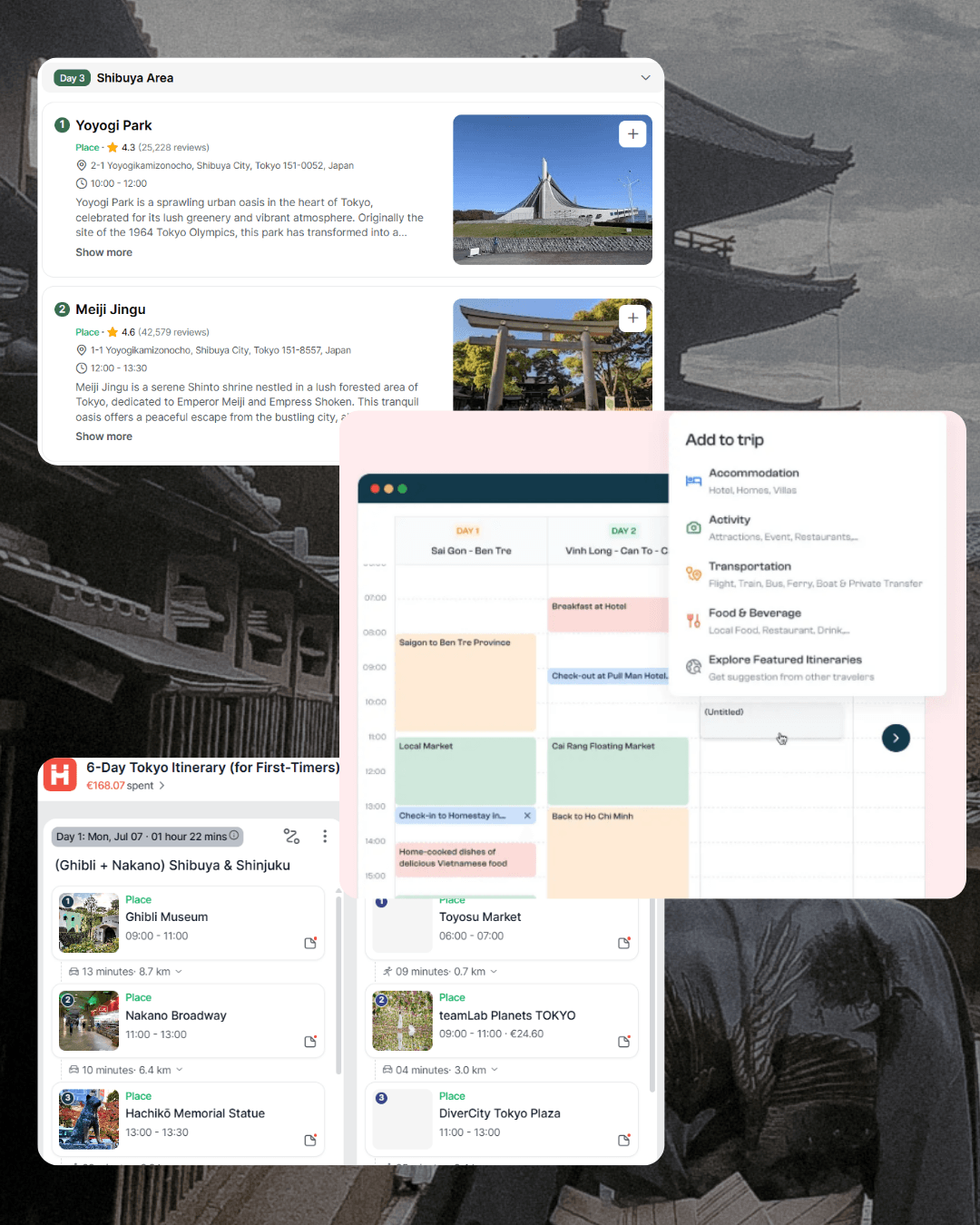
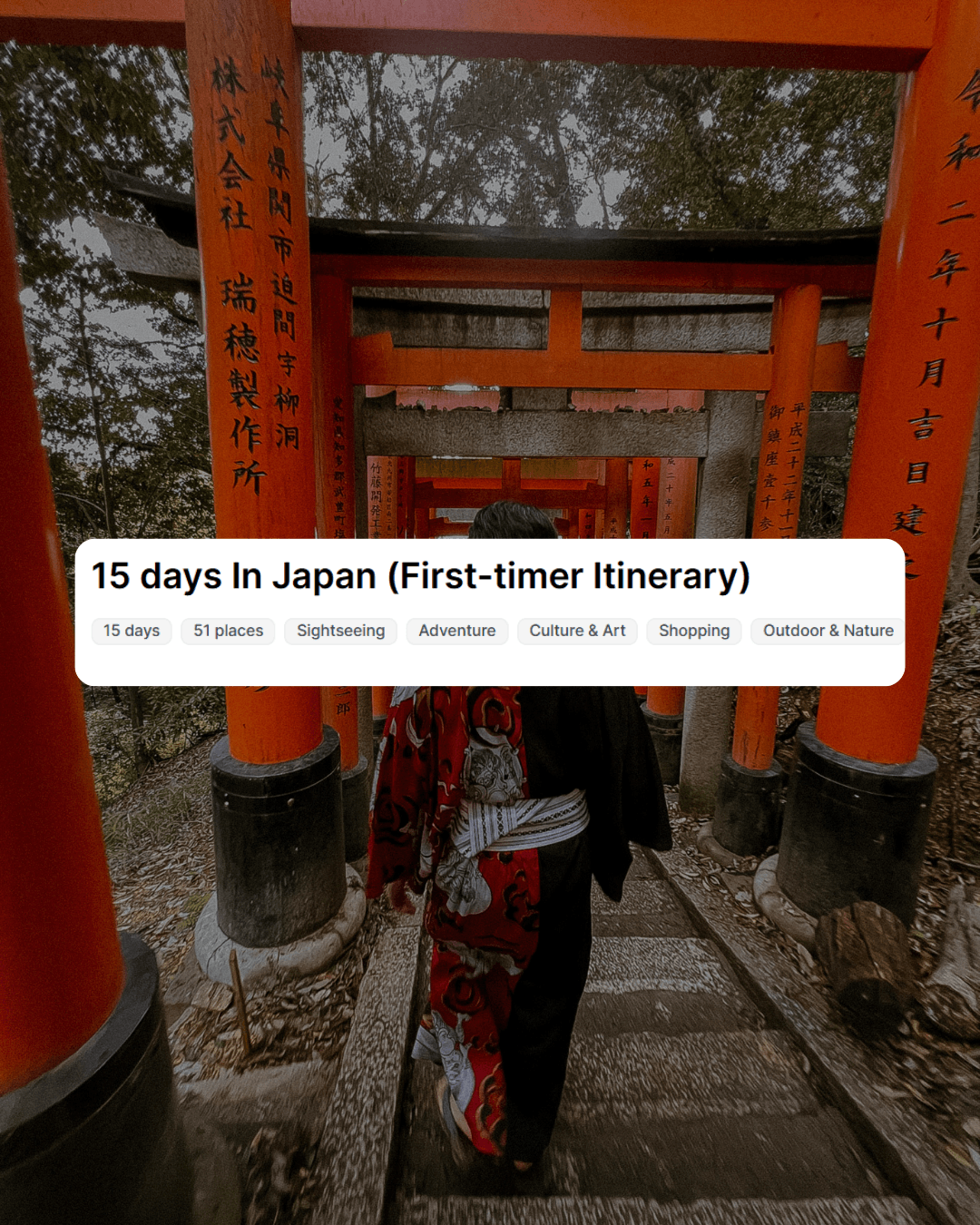
🗾 15–20 Day Full Japan Itinerary - Free
✅ Includes Tokyo, Kyoto, Osaka, Nara, day trips & more
✅ Balanced pace, curated flow
✅ Map view + calendar
The truth?
Planning a trip to Japan is hard because there’s:
– Too much information
– Conflicting advice
– Unclear transport options
– Itineraries made for "perfect tourists", not real humans
And your situation is unique.
You might be traveling:
– As a couple who wants slow, meaningful days
– With your family and need to balance nap times & sights
– Solo, with a passion for anime, food, or hiking
Most guides weren’t made for your rhythm.

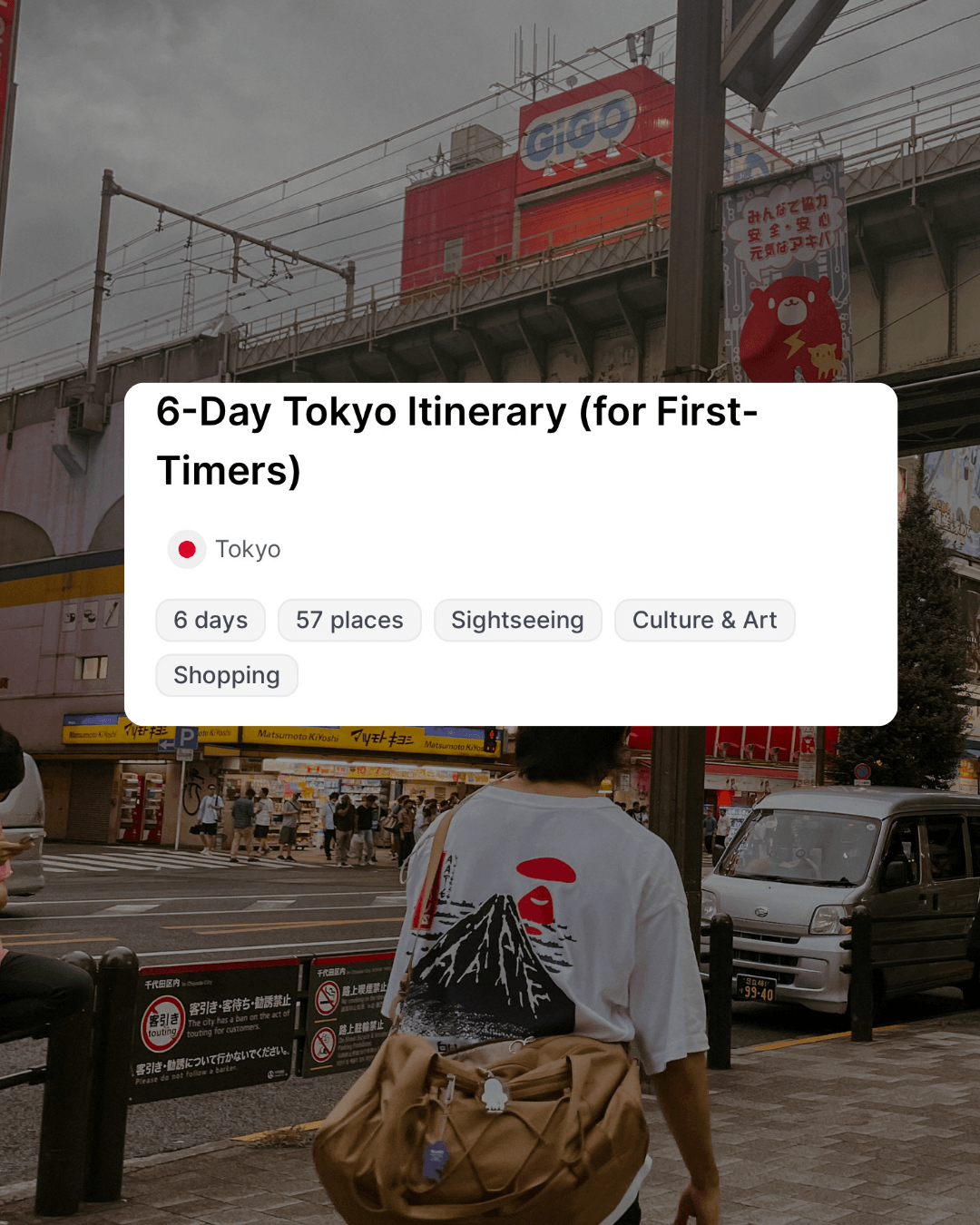
🏙️ 6-Day Tokyo Itinerary
Tokyo can be overwhelming, but not with this guide.
I created this plan to help you hit all the best spots while keeping things organized and doable.
✅ Covers Shibuya, Shinjuku, Asakusa, Akihabara, Harajuku, and more
✅ No zigzagging: each day focuses on 2–4 areas
✅ Suggested timings for key activities and transitions
✅ Map View + Calendar View via Holicay
✅ Budget breakdown + booking links
✅ Add your own flights/hotels
✅ Fully editable + shareable
Perfect if: you're visiting Tokyo for the first time and want structure without stress.
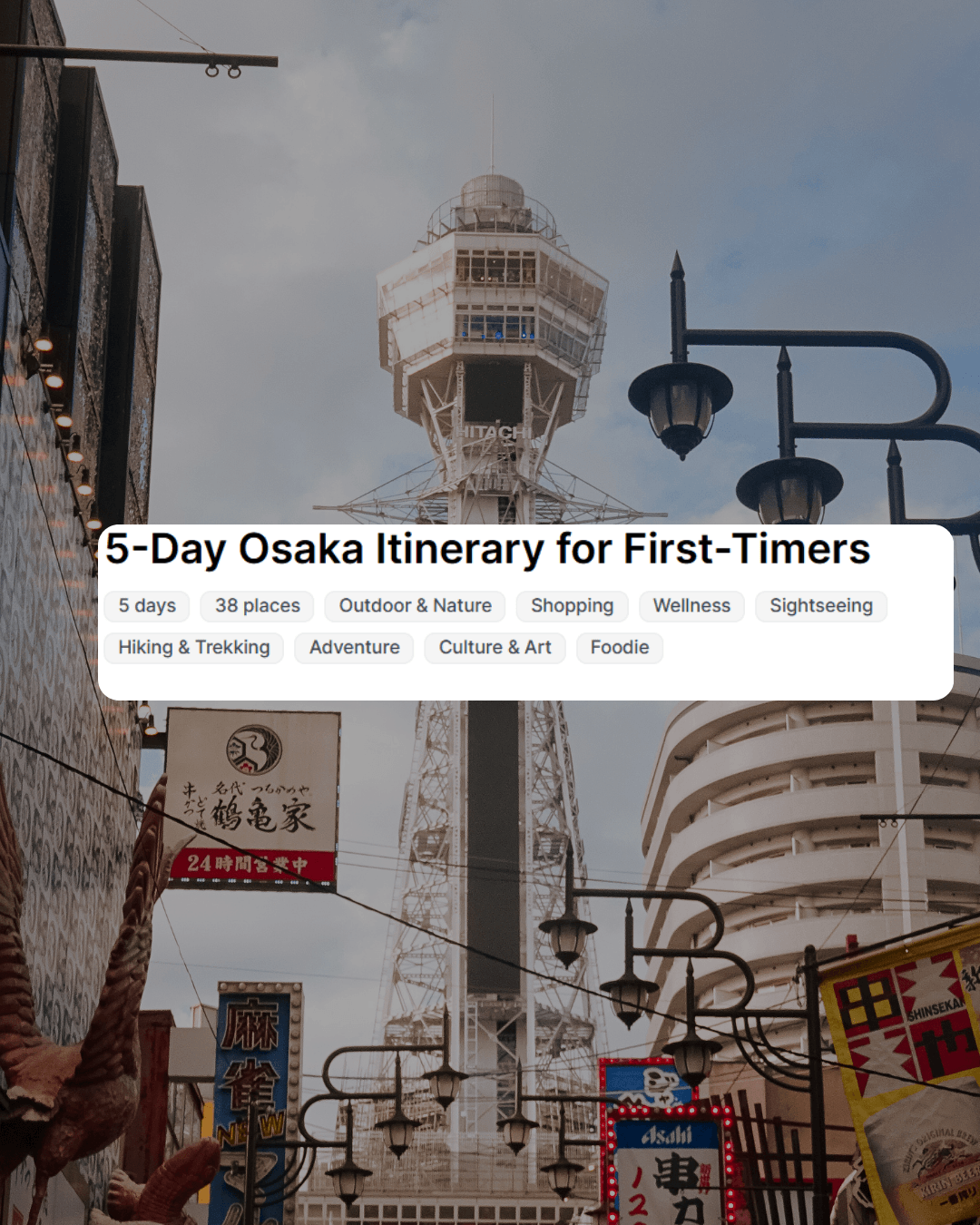
🏙️ 5-Day Osaka Itinerary
Planning your first trip to Osaka?
This 5 day itinerary is designed to help you experience the best of the city, from iconic landmarks and lively
neighborhoods to local gems and local flavors.
At first glance, it might seem like a lot, but don’t worry.
Each day focuses on 2 to 3 nearby areas, so you won’t waste time zigzagging across the city. The plan is crafted to show you as much as possible without the overwhelm.
You’ll get suggested timings, routes, and must-try stops to make your navigation smooth and stress-free. Of course, this is just a guide, feel free to tweak it, skip, or stretch things to match your own rhythm.
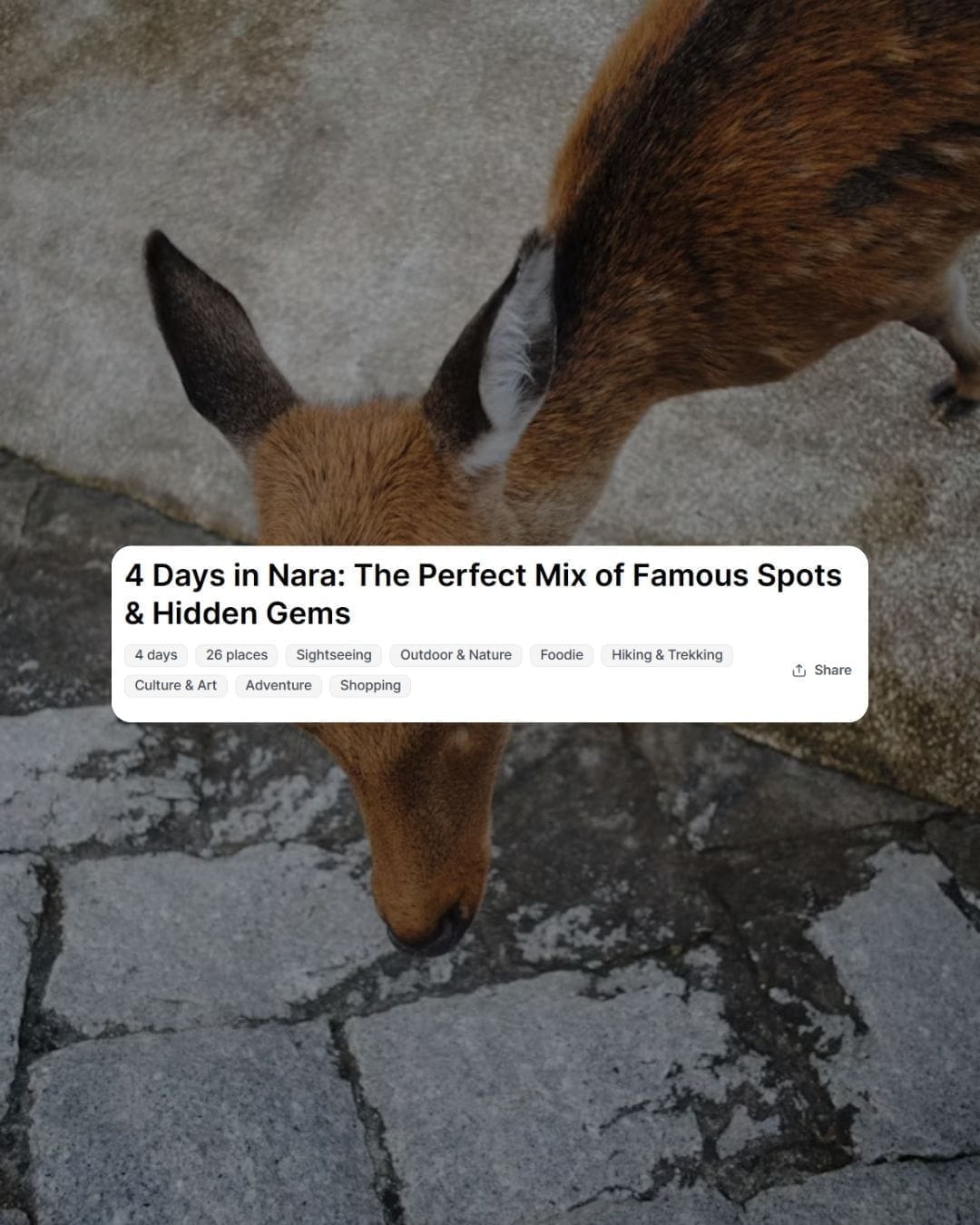
🦌 3 days in Nara
Looking for more than just deer in Nara? This 4-day itinerary gives you everything: iconic temples, charming old streets, peaceful mountain escapes, all organized by area so you won’t waste time zigzagging around.
Here’s what you get:
✅ A smooth day in central Nara: Todai-ji, Kasuga Taisha, and Nara Park (yes, with the deer)
✅ A deep dive into Japan’s past in Imaichō and the stunning hillside temple Hasedera
✅ A sacred mountain journey through Yoshino and its dramatic views and temples
✅ And a chill last day in Ikoma, riding a vintage cable car and watching the sunset from an amusement park in the sky
No guesswork, no stress, just a perfectly curated trip through Nara's best-known spots and the ones most tourists miss.
🗺️ Includes: routes, suggested times, restaurant stops, and local insights
📍 Fully customizable with Holicays
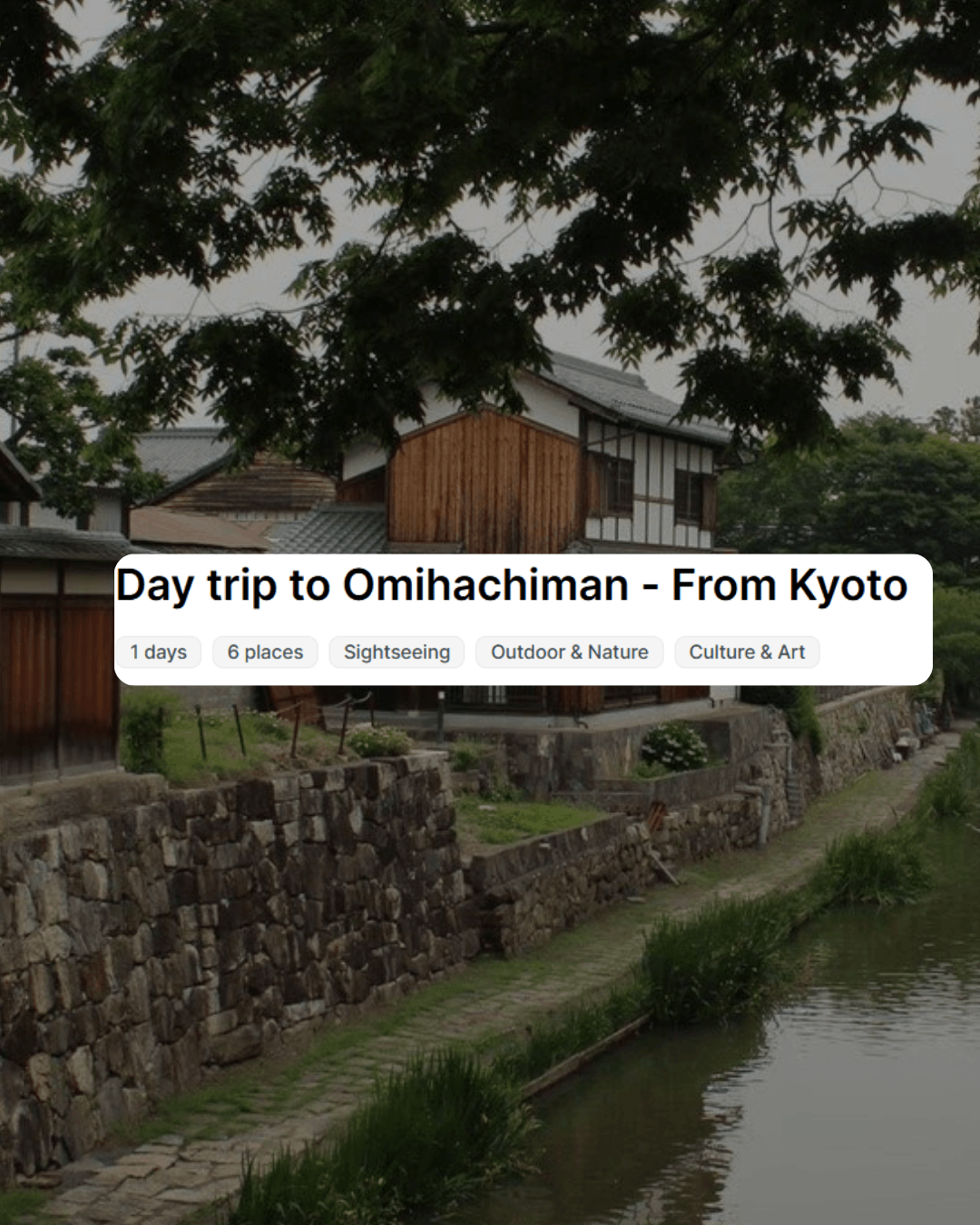
Day trip to Omihachiman
Escape the crowds and step into a postcard-perfect town just 1 hour from Kyoto or Nara. Ōmihachiman is a preserved merchant city with Edo-era canals, traditional houses, and peaceful vibes you won’t find in the big cities.
💡 Perfect if you want a break from Kyoto’s rush and a real taste of small-town Japan.
No need to plan, just follow the route, relax, and enjoy the charm.
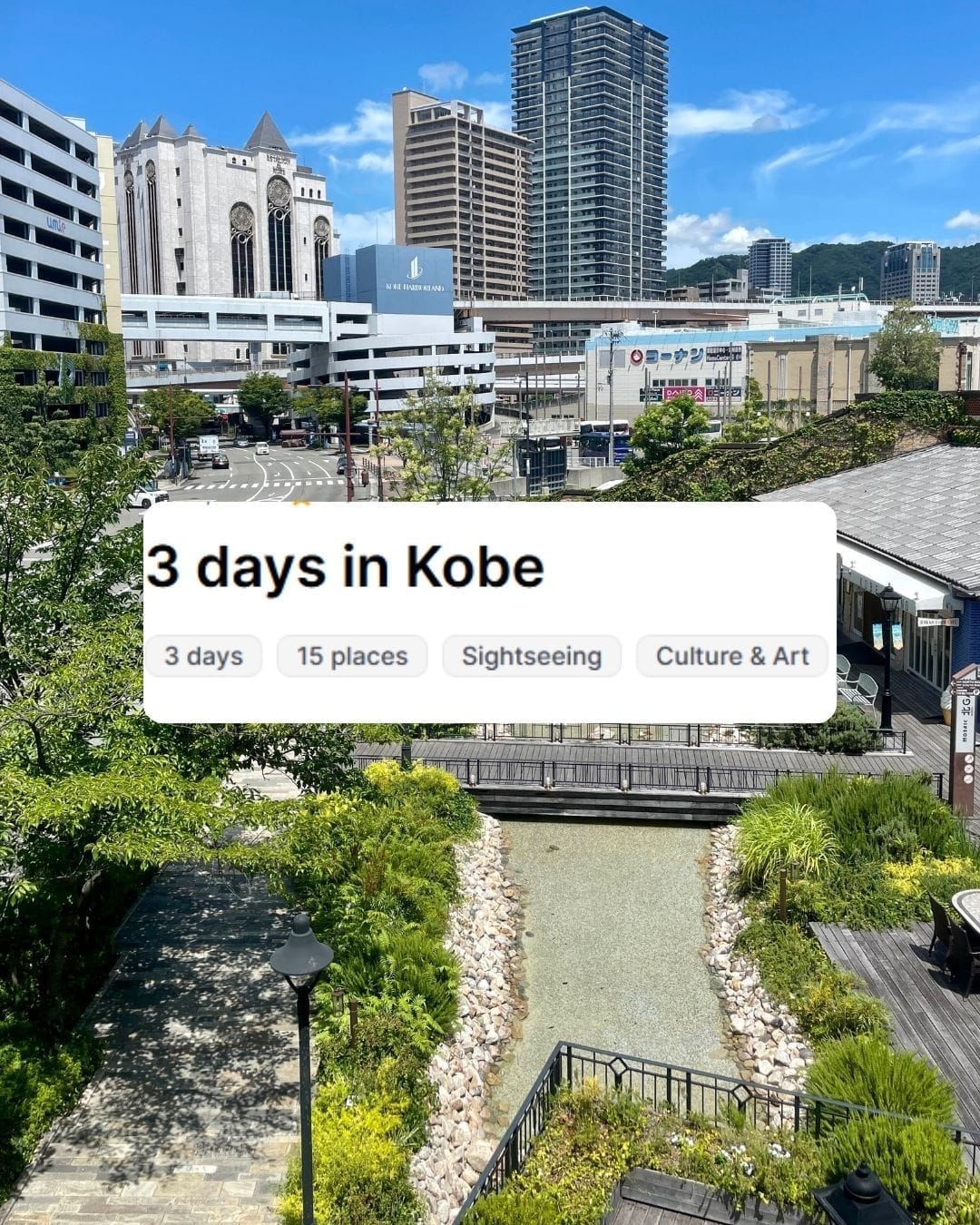
3 DAYS IN KOBE
This 3-day itinerary gives you the best of Kobe : famous views & spots, hot springs all planned by area so you don’t waste time zigzagging around.
No guesswork, no stress just a perfectly curated trip through Kobe's best-known spots and the ones most tourists miss.
🗺️ Includes: routes, suggested times, restaurant stops, and local insights
📍 Fully customizable with Holicay
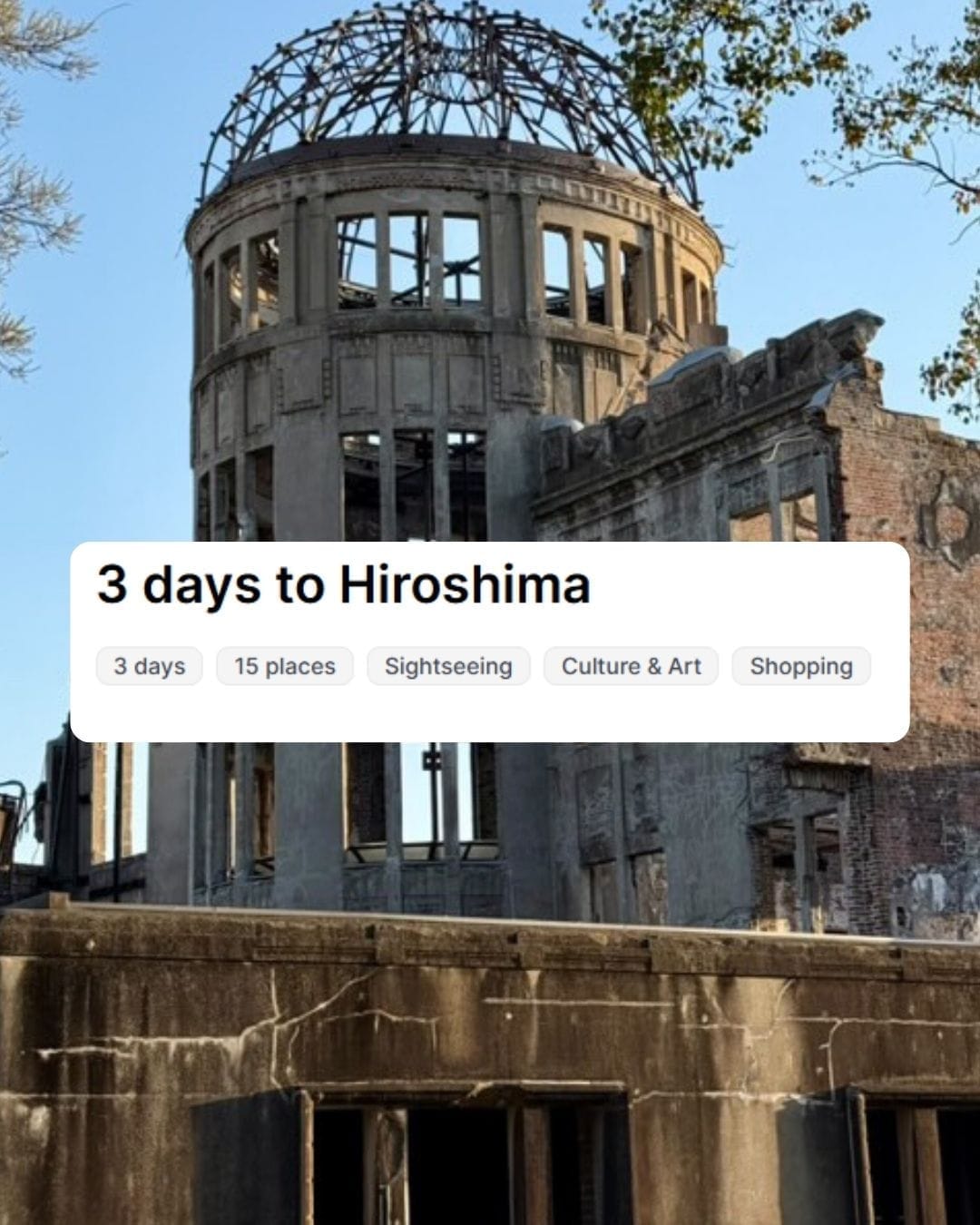
3 DAYS IN HIROSHIMA
This 3-day itinerary gives you everything: Hiroshima city, emotional landmarks, views, Ikutsushima, and all grouped by area so you don’t waste time zigzagging across the city.
No guesswork, no stress just a perfectly curated trip through Hiroshima's best-known spots.
🗺️ Includes: routes, suggested times, restaurant stops, and local insights
📍 Fully customizable
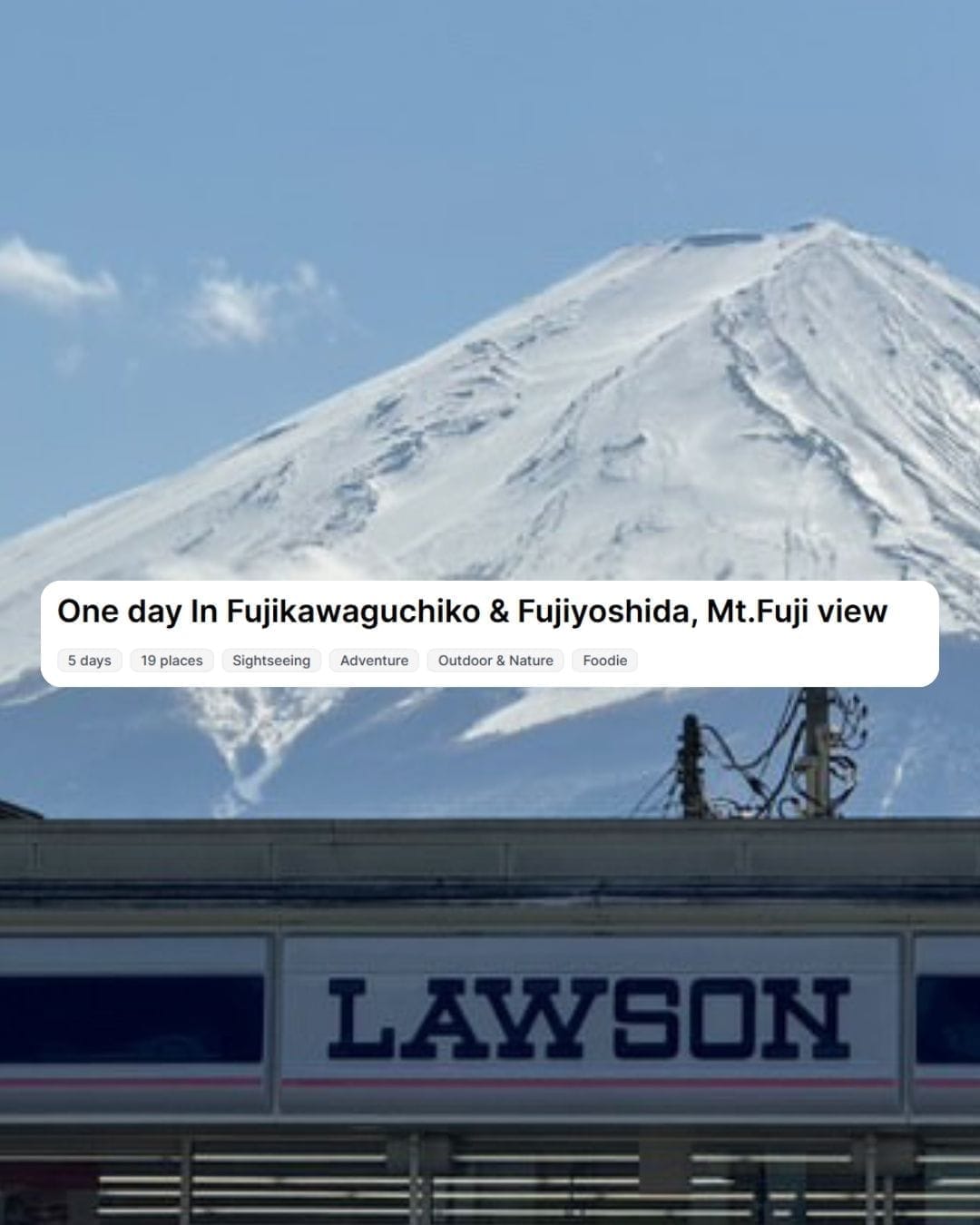
One day In Fujikawaguchiko & Fujiyoshida, Mt.Fuji view
I’ve created several day trip options for Mount Fuji, but to be clear : they’re all one-day itineraries with different themes or routes. You can mix and match them depending on your interests, or even turn them into a 2- or 3-day trip if you want to explore more slowly. The spots I’ve recommended work great for either a quick visit or a longer stay!
No guesswork, no stress just a perfectly curated trip through Mt. FUJI best-known spots and the ones most tourists miss.
🗺️ Includes: routes, suggested times, restaurant stops, and local insights
📍 Fully customizable with Holicay
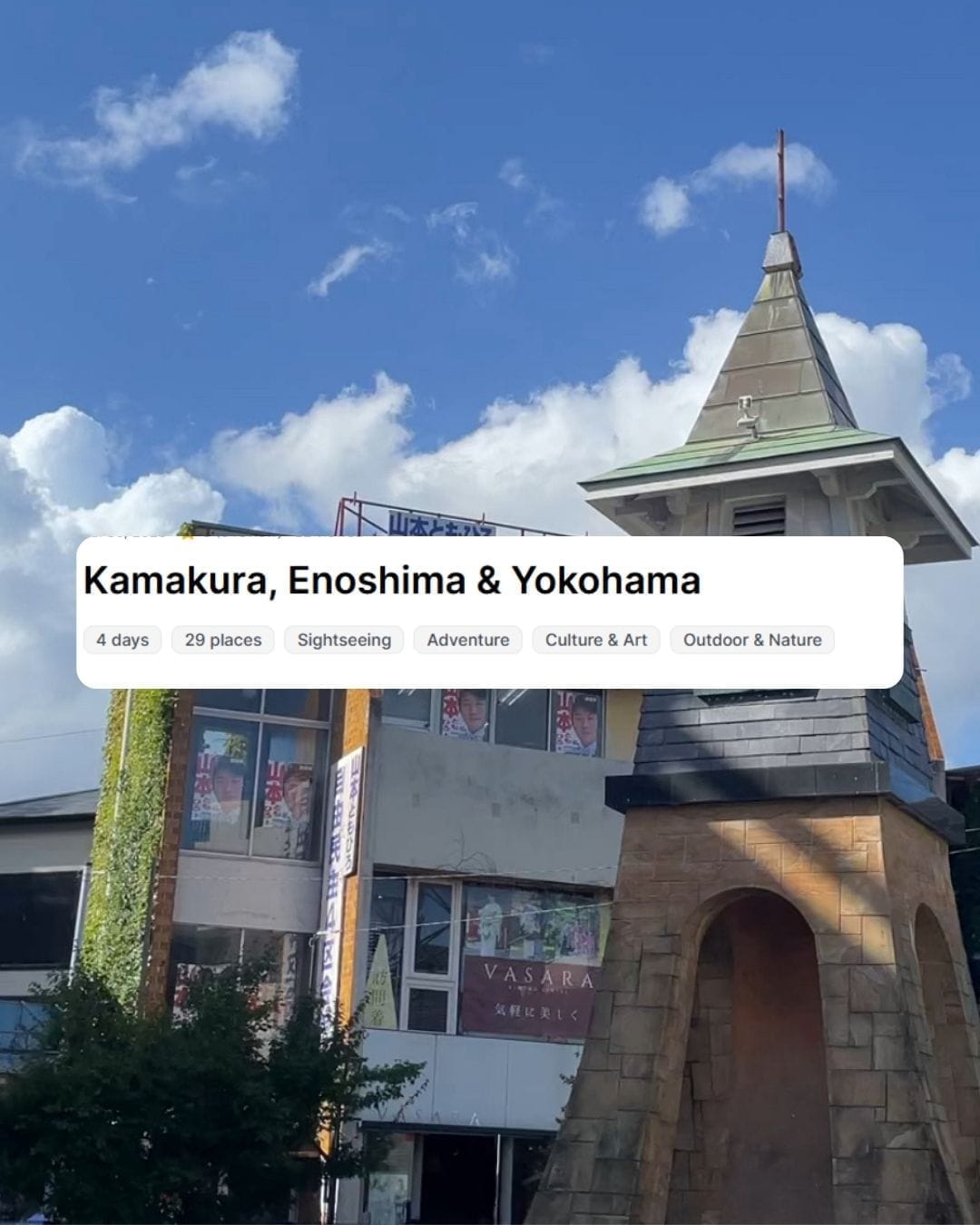
Kamakura, Enoshima & Yokohama
Several day trip options between Yokohama, Enoshima and Kamakura.
Spend the day in Kamakura (temples + beach), combine with Enoshima for island walks and sea views, or head to Yokohama for a more urban vibe. You can do them separately or link them depending on your pace. I've share many options!
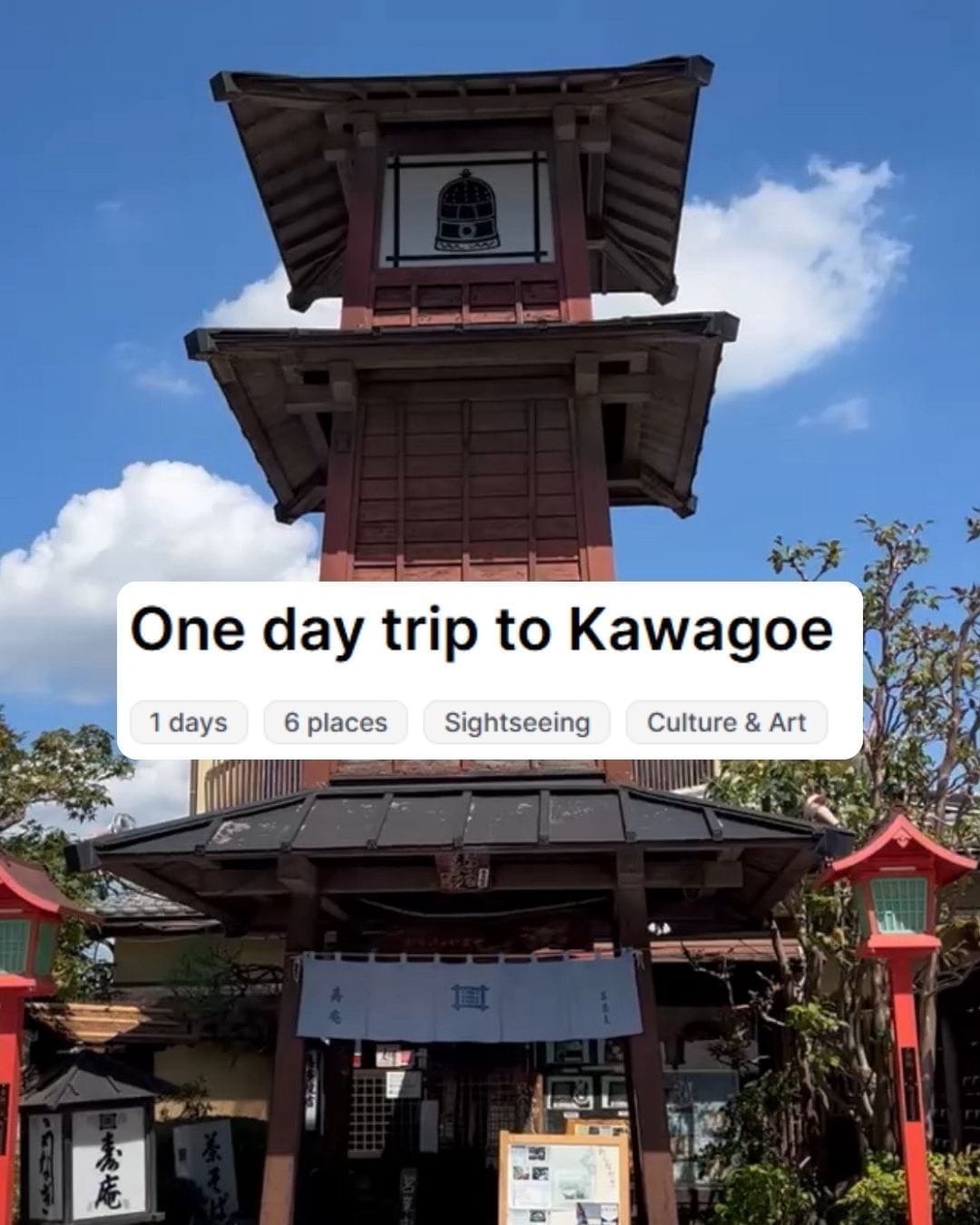
One day trip to Kawagoe
Kawagoe, often called “Little Edo,” is a charming town just 30 minutes from Tokyo, perfect for a one-day escape into Japan’s past. Once a key commercial hub during the Edo period, Kawagoe still preserves the architecture and spirit of that era, with clay-walled warehouses, wooden merchant houses, and the iconic Toki no Kane (Time Bell Tower) that still chimes today.
THE REAL COST OF TRAVELLING JAPAN
FLIGHTS
Flights vary a lot:
✈️ Where you come from
✈️ Direct or connecting
Approx. cost (Europe–Tokyo):
💶 600–1,200€ round trip
✈️ Tip: Use Google flight or Skyscanner & alerts to save.
My last trip from Reunion island costed around 1000€
ACCOMODATION
Budget can change everything:
🏠 Hostels: ~€30–€50/night
🏨 Mid-range hotels: ~€80–€150/night
✨ Ryokan/luxury: ~€200+ per night
Tip: Book early, stay near stations.
My last trip we were a group of 9 people, went mostly to Airbnb, and that costed around 500€ for 3
ACTIVITIES
It depends on what you love:
🌿 Free: Parks, temples, local markets
🎨 Paid: TeamLab (25€, Ghibli (90€), castles
🍣 Splurge: Kobe beef dinner (~80–150€), sushi chef experience
My last trip we did many free things, and some paid activity or temples. Overall it was not more than 100€.
TRANSPORTATION
🚅 Bullet trains are fast…but not cheap.
Examples:
– Tokyo–Kyoto one-way: ~€100
– Suica/IC card for metros: recharge as you go for regular trains.
My last trip we spent around 200€ on regular transporation and back then JR pass was 250€ for 1 week/ So around 450€
TOOLS TO PLAN
I recommend: Holicay : interactive trip planner, organize budgets & activities. Help you keep track of everything.
Japan is a country that blends centuries-old traditions with futuristic innovation. Whether you’re marveling at towering skyscrapers in Tokyo, strolling through Kyoto’s historic temples, or soaking in an onsen with a view of Mount Fuji, Japan offers an unforgettable experience. This 15-day itinerary is designed for first-time visitors, covering iconic destinations while ensuring a smooth and immersive journey through the Land of the Rising Sun.
TOKYO
Day 1-4: Tokyo – The Vibrant Metropolis
Day 1: Arrival & First Impressions
Morning: Arrival and Connectivity
Land at Narita or Haneda Airport and complete immigration and customs procedures.
Pick up a ESIM card to ensure seamless internet access throughout your journey. This will be essential for navigation, translations, and instant travel tips.
HOLAFLY : get 5% off with my code Tabimawari.
Withdraw yen from ATMs inside the airport, or at a Seven Eleven as Japan remains a cash-reliant country, especially for small restaurants and local transportation.
Afternoon: Transfer & Check-in
Transfer to central Tokyo: From Narita Airport: Take the Narita Express (N'EX) for a direct, comfortable ride to Shinjuku or Tokyo Station, or opt for the more affordable Keisei Skyliner if staying in Ueno or Asakusa. From Haneda Airport: The Keikyu Line connects to Shinagawa and Asakusa, while the Tokyo Monorail is a quick option for reaching Hamamatsucho.
Check into a hotel in Shinjuku, Shibuya, or Ginza, offering convenient access to Tokyo’s major attractions and efficient train connections.
If you arrive early, take a quick walk to a nearby convenience store (konbini) such as 7-Eleven, Lawson, or FamilyMart, to grab an onigiri (rice ball), bento, or matcha drink to recharge.
Evening: First Exploration of Tokyo’s Nightlife
Head to Shinjuku, Tokyo’s bustling entertainment hub, and immerse yourself in the electrifying city lights.
Explore Kabukicho, Tokyo’s lively red-light district, filled with neon signs, bars, and entertainment venues. Wander through the area but stay aware of overly aggressive touts.
Walk to Omoide Yokocho (Memory Lane), a nostalgic alleyway lined with tiny eateries offering delicious yakitori (grilled skewers) and izakaya-style food. Try skewers of chicken, pork, or vegetables, and pair them with a local highball or sake for an authentic experience.
End the evening with a panoramic view of Tokyo’s skyline from the Tokyo Metropolitan Government Building’s observation deck. It’s free of charge, and on clear days, you might even spot Mount Fuji in the distance.
If you're not ready to sleep, stop by Golden Gai, a historic network of tiny, themed bars that accommodate only a few guests each, offering an intimate and unique nightlife experience.
Alternative Late-Night Options:
Shinjuku Batting Center – Try your hand at Japanese baseball culture.
Robot Restaurant (reopened now it's samurai restaurant) – A quirky, high-energy dinner show with robots, neon lights, and performances.
Don Quijote (Donki) Shinjuku – A 24-hour megastore for quirky souvenirs, snacks, and travel essentials
Day 2: Modern Tokyo & Cultural Gems
Morning: Discover Asakusa – The Historic Heart of Tokyo
Begin your day in Asakusa, one of Tokyo’s most traditional districts, home to the iconic Senso-ji Temple, Tokyo’s oldest and most significant Buddhist temple.
Walk through Kaminarimon Gate, the grand entrance featuring a massive red lantern, a famous Instagram spot in Tokyo.
Stroll along Nakamise Street, a vibrant shopping street where you can sample authentic Japanese street food:
Ningyo-yaki (small sponge cakes filled with red bean paste) Senbei (traditional rice crackers, available in soy sauce or wasabi flavor) Taiyaki (fish-shaped pastries filled with custard or sweet red bean paste)
Afternoon: Anime, Manga & Gaming Paradise in Akihabara
Travel to Akihabara, the mecca of otaku culture, anime, and gaming in Tokyo. This neighborhood is a must-visit for fans of Japanese pop culture.
Visit Animate Akihabara, a multi-story paradise for manga, anime merchandise, and exclusive collectibles.
Explore Yodobashi Camera, one of Tokyo’s largest electronics stores, perfect for tech gadgets, camera gear, and gaming consoles.
Experience Akihabara’s famous maid cafés, where staff dressed as maids provide a unique themed dining experience. Some popular choices include @Home Café and Maidreamin.
Evening: Odaiba – Tokyo’s Futuristic Waterfront
Board the Yurikamome Line, an automated train offering scenic views of Tokyo Bay, and head to Odaiba, a man-made island known for futuristic attractions.
Visit teamLab Borderless an immersive digital art museum perfect for Instagram-worthy Tokyo photos (advance booking recommended).
Marvel at the life-size Gundam Unicorn statue, a must-see for mecha anime fans.
Enjoy a night walk along Odaiba Seaside Park, offering panoramic views of the Rainbow Bridge and Tokyo Tower illuminated at night.
Day 3: Fashion, Shopping, and Local Culture
Morning: Serenity at Meiji Shrine & Youth Culture in Harajuku
Start your day at Meiji Shrine, a sacred site dedicated to Emperor Meiji, nestled within Yoyogi Park’s lush forest. This is one of Tokyo’s best spiritual and cultural experiences.
After the shrine, walk to Takeshita Street in Harajuku, the heart of Tokyo’s Kawaii culture and alternative fashion.
Browse quirky shops like: WEGO for trendy Harajuku fashion. Daiso Harajuku for affordable Japan-themed souvenirs. Kiddy Land for Sanrio, Studio Ghibli, and Pokémon merchandise.
Try Harajuku’s famous crepes from Santa Monica Crepes or Marion Crepes, filled with whipped cream, fruits, and ice cream.
Afternoon: Luxury Shopping & Hidden Cultural Spots
Walk through Omotesando, often called the Champs-Élysées of Tokyo, home to designer brands, concept stores, and architectural masterpieces.
Visit Nezu Museum, a hidden cultural gem with Japanese tea houses, a traditional garden, and an impressive art collection.
Enjoy lunch at Aoyama Flower Market Tea House, a café inside a floral shop, offering an elegant, Instagram-worthy ambiance.
Evening: The Energy of Shibuya
Head to Shibuya Crossing, the world’s busiest pedestrian intersection, and capture an aerial view from Shibuya Sky or Mag’s Park (rooftop of Magnet by Shibuya 109).
Take a photo with Hachiko Statue, a tribute to Japan’s most loyal dog.
Shop at Shibuya 109, Tokyo’s most famous department store for women’s fashion and streetwear trends.
End the night with a Michelin-starred ramen experience at Ichiran Ramen (famous for its solo dining booths)
Day 4: Day Trip to Nikko or Kamakura
Option 1: Nikko – A Journey Through Japan’s UNESCO Heritage
Take the Tobu Limited Express to Nikko, one of the most important historical sites in Japan.
Visit Toshogu Shrine, the ornate and lavish mausoleum of Tokugawa Ieyasu, featuring intricate gold leaf carvings.
Explore Kegon Falls, one of Japan’s most breathtaking waterfalls, surrounded by vibrant autumn foliage or lush summer greenery.
Walk along the shores of Lake Chuzenji, a serene alpine lake offering peaceful views and local onsen resorts.
Try yuba (tofu skin), a specialty dish in Nikko, often served in ramen or as a standalone delicacy.
Option 2: Kamakura – Coastal Beauty & Samurai History
Take the Yokosuka Line to Kamakura, a historic town known for its samurai heritage and Zen temples.
Visit the Great Buddha (Daibutsu), an impressive 13-meter bronze statue dating back to the 13th century.
Stop by Hasedera Temple, famous for its stunning hydrangea garden in summer and panoramic views of the coastline.
Walk along Komachi Street, a lively shopping street filled with traditional souvenirs, local snacks, and matcha ice cream.
If time allows, hike to Zeniarai Benten Shrine, a mystical cave shrine where visitors wash coins in sacred waters for prosperity.
MONT FUJI
Day 5 : Journey to Hakone & Onsen Experience
Morning: Scenic Train Ride to Hakone
Depart from Shinjuku Station and board the Romancecar, a comfortable scenic train with large windows, taking you directly to Hakone-Yumoto Station (1.5 hours).
If you have the Hakone Free Pass, you’ll have unlimited access to transportation in the Hakone area, including buses, cable cars, and the Lake Ashi cruise.
Stop by a konbini (convenience store) or a bakery inside Shinjuku Station before departure to grab a quick breakfast, such as melonpan, onigiri, or a matcha latte.
Afternoon: Art, Lake Ashi & Mount Fuji Views
Hakone Open-Air Museum: Begin your exploration at this unique outdoor museum, where modern sculptures blend harmoniously with Hakone’s mountainous landscape. Highlights include:The Picasso Pavilion, featuring over 300 pieces of Picasso’s artwork. The Symphonic Sculpture, a colorful stained-glass tower offering panoramic views from the top.
Lake Ashi Pirate Cruise: Hop on a pirate-themed sightseeing boat and sail across Lake Ashi. On clear days, enjoy stunning views of Mount Fuji reflecting on the water.
Hakone Shrine: If time permits, visit the red torii gate of Hakone Shrine, standing majestically in the lake—a classic Japan travel photo spot.
Evening: Ryokan Stay & Onsen Relaxation
Check into a ryokan (traditional Japanese inn), an essential Hakone experience. Two highly recommended options:Gora Kadan – A luxury ryokan with private open-air hot spring baths and an impeccable kaiseki dinner (traditional multi-course Japanese meal)..
Onsen Bathing Etiquette: Rinse off before entering the bath. Avoid bringing towels into the water. Enjoy the mineral-rich waters known for their healing properties.
Dinner: Savor a traditional kaiseki meal, featuring seasonal delicacies such as sashimi, simmered vegetables, miso soup, and wagyu beef.
Day 6: Scenic Views & Mount Fuji
Morning: Owakudani – A Volcanic Wonderland
Ride the Hakone Ropeway to Owakudani, an active volcanic valley famous for its sulfur vents and hot springs.
Try the famous black eggs (Kuro-Tamago), boiled in the sulfuric hot springs—legend says that eating one will add seven years to your life!
Capture breathtaking photos of Mount Fuji, especially if visiting during autumn or winter, when the skies are clearest.
If you're feeling adventurous, hike from Owakudani to Togendai for additional scenic mountain views.
Afternoon: Shopping & Alternative Cultural Experience
Gotemba Premium Outlets: One of Japan’s largest outlet malls, featuring luxury brands like Prada, Gucci, Burberry, and local favorites like Uniqlo and Onitsuka Tiger. Located near Mount Fuji, the rooftop terrace offers postcard-worthy views of the mountain. If shopping isn’t your priority, take a break at Godiva Café or enjoy Japanese-style soufflé pancakes.
OR
Hakone Venetian Glass Museum: A European-inspired museum showcasing beautiful Venetian glass art and a romantic garden with crystal-adorned trees. Enjoy an elegant tea break at the museum’s café, surrounded by Italian-style architecture and Hakone’s natural beauty.
Evening: Shinkansen Ride to Kyoto
Board the Shinkansen (bullet train) from Odawara Station to Kyoto (approx. 2 hours).
Grab an ekiben (train bento box) at the station, featuring delicacies like teriyaki eel, sushi, or katsu sandwiches, perfect for enjoying during the ride.
Arrive in Kyoto in the evening and check into a hotel in Gion or Higashiyama, offering easy access to Kyoto’s famous temples, traditional streets, and geisha district.
KYOTO
Day 7: Kyoto’s Famous Temples & Traditional Streets
Morning: Kinkaku-ji – The Golden Pavilion
Start the day with a visit to Kinkaku-ji (Golden Pavilion), one of Kyoto’s most iconic and picturesque landmarks.
The gold-leaf-covered temple reflects beautifully in the surrounding pond, creating a breathtaking photo opportunity.
Explore the zen gardens and tea houses within the temple grounds for a tranquil start to your Kyoto adventure.
Afternoon: Arashiyama Bamboo Grove & Monkey Park
Head west to Arashiyama, a scenic district filled with natural beauty and historic charm.
Walk through the Bamboo Grove, where towering green stalks create a surreal and peaceful atmosphere.
Cross the Togetsukyo Bridge, offering a stunning panoramic view of the mountains and river.
Hike up to Iwatayama Monkey Park, where wild Japanese macaques roam freely. Feed them while enjoying one of the best views of Kyoto from the hilltop.
Evening: Gion – Kyoto’s Traditional Nightlife
As the sun sets, explore Gion, Kyoto’s most famous geisha district.
Walk through Hanamikoji Street, lined with historic wooden machiya houses and traditional tea houses.
If lucky, you might spot a geisha or maiko (apprentice geisha) on their way to an evening engagement. But please don't take any photos and be respectful.
For dinner, try Kyo-kaiseki cuisine, a refined multi-course meal featuring seasonal and artistic dishes
Day 8: Fushimi Inari & Nara Day Trip
Morning: Fushimi Inari Shrine – The Thousand Torii Gates
Visit the legendary Fushimi Inari Taisha, one of Japan’s most recognizable shrines, famous for its thousands of vermilion torii gates.
Walk along the torii-lined trail, passing through smaller shrines and fox statues (messengers of the deity Inari).
Hike up Mount Inari for a panoramic view of Kyoto, or simply explore the lower pathways if you prefer a shorter visit.
Afternoon: Nara – Japan’s Ancient Capital
Take the JR Nara Line to Nara, Japan’s first permanent capital, known for its historic temples and friendly deer.
Visit Todai-ji Temple, home to the Great Buddha (Daibutsu), one of the largest bronze Buddha statues in the world.
Walk through Nara Park, where sacred deer roam freely. Buy special deer crackers (shika senbei) and experience their unique bowing behavior.
Explore Kasuga Taisha Shrine, known for its thousands of bronze lanterns.
Evening: Kaiseki Dining in Kyoto
Return to Kyoto and indulge in a traditional kaiseki dinner, an artful multi-course meal featuring seasonal Kyoto delicacies.
Recommended kaiseki restaurants: Kikunoi (Michelin-starred) Gion Nanba (for a refined but less expensive experience) Giro Giro Hitoshina (casual yet creative kaiseki experience)
Day 9: Higashiyama & Philosopher’s Path
Morning: Kiyomizu-dera – Kyoto’s Most Famous Temple
Start in Higashiyama, Kyoto’s well-preserved historic district.
Visit Kiyomizu-dera Temple, an architectural masterpiece with a massive wooden stage offering a breathtaking view over Kyoto.
Walk through Sannenzaka & Ninenzaka, two charming sloped streets lined with traditional shops selling matcha sweets, handcrafted souvenirs, and Kyoto ceramics.
Afternoon: The Philosopher’s Path
Enjoy a leisurely stroll along the Philosopher’s Path, a serene canal-side walk lined with cherry blossoms in spring and vibrant foliage in autumn.
Stop by: Nanzen-ji Temple, a beautiful Zen temple with a massive wooden gate. Eikan-do Temple, famous for its autumn maple leaves. Honen-in Temple, a quiet and underrated temple hidden in the woods.
Evening: Japanese Tea Ceremony Experience
Attend a Japanese tea ceremony, an essential Kyoto cultural experience emphasizing harmony, respect, purity, and tranquility.
Day 10: Uji or Kurama – Cultural & Nature Escape
Option 1: Uji – The Capital of Green Tea
Take the JR Nara Line to Uji, a picturesque town famous for its high-quality green tea.
Visit Byodo-in Temple, a UNESCO World Heritage Site, featured on the Japanese 10-yen coin.
Enjoy a tea-tasting experience at a traditional Uji tea house.
Cross Uji Bridge, one of Japan’s oldest bridges, offering stunning riverside views.
Option 2: Kurama – Mystical Temples & Hot Springs
Take the Eizan Electric Railway to Kurama, a mountain village known for its spiritual energy and natural beauty.
Hike to Kurama-dera Temple, a mystical Buddhist temple with incredible mountain views.
Visit Kibune Shrine, dedicated to the Shinto water deity, and enjoy lunch at a riverside kawadoko restaurant (in summer, you can dine over a flowing stream!).
End your day at Kurama Onsen, one of the best outdoor hot springs near Kyoto, where you can relax in nature before returning to the city.
OSAKA
Day 11-12: Osaka – The Food Capital of Japan
Osaka is Japan’s kitchen, famous for its street food, vibrant nightlife, and historical landmarks. Known for its friendly locals and energetic city vibe, Osaka offers a perfect mix of cultural heritage and modern entertainment.
Day 11: Arrival & Exploring Osaka’s Iconic Landmarks
Morning: Travel to Osaka & Osaka Castle
Take the Shinkansen from Kyoto to Osaka (15 minutes) or take the train (30 to 45 minutes) and check into your hotel in Namba, Umeda, or Shinsaibashi, ideal for sightseeing and food-hopping.
Begin your exploration at Osaka Castle, one of Japan’s most impressive historical landmarks.Explore the castle museum, which showcases Osaka’s samurai history and battles. Walk through Osaka Castle Park, a beautiful spot for cherry blossoms in spring and autumn foliage. Visit the Hokoku Shrine, dedicated to Toyotomi Hideyoshi, the powerful daimyo who built Osaka Castle.
Afternoon: Shinsekai & Tsutenkaku Tower
Head to Shinsekai, a retro district known for its Showa-era vibes, colorful billboards, and deep-fried street food.
Try kushikatsu (deep-fried skewers of meat, seafood, and vegetables) at famous spots like Daruma.
Visit Tsutenkaku Tower, Osaka’s version of the Eiffel Tower, for panoramic city views.
Explore Spa World, a multi-floor onsen theme park featuring Japanese and European-style baths (optional relaxation experience).
Evening: Dotonbori – Osaka’s Famous Food & Nightlife District
Walk along Dotonbori, Osaka’s most famous entertainment district, filled with giant neon billboards, bustling restaurants, and lively bars.
Snap a photo in front of the Glico Running Man sign, one of Osaka’s most iconic landmarks.
Try Osaka’s signature street foods:Takoyaki (octopus balls) – Best at Kukuru or Wanaka. Okonomiyaki (savory Japanese pancake) – Try at Mizuno or Chibo. Negiyaki (green onion pancake) – A lesser-known specialty worth tasting.
If you want to experience Osaka’s crazy nightlife, visit Osaka's izakaya and bars in Shinsaibashi or Amerikamura (Amemura).
Day 12: Modern Attractions & Cultural Experience
Morning: Umeda Sky Building & Shopping in Umeda
Head to Umeda Sky Building, one of Osaka’s most futuristic skyscrapers, featuring the Floating Garden Observatory with 360-degree views of the city skyline.
Grab a Japanese-style breakfast or coffee at Grand Front Osaka, a shopping and dining complex near Osaka Station.
Explore Hankyu and Daimaru department stores for luxury brands, or Yodobashi Camera for electronics and gaming.
Afternoon: Osaka’s Quirky & Fun Side
Choose between two must-see Osaka attractions:
Option 1: Universal Studios Japan (USJ) – A Thrilling Experience
Spend the afternoon at Universal Studios Japan (USJ), home to:The Wizarding World of Harry Potter – Walk through Hogwarts Castle and drink butterbeer. Super Nintendo World – A must-visit for Mario fans, where you can collect virtual coins and race on Mario Kart: Koopa’s Challenge. Jurassic Park, Minion Park, and Hollywood Dream rides for adrenaline seekers.
USJ is a full-day attraction, so plan accordingly if you choose this option.
Option 2: Osaka’s Hidden Gems & Cultural Side
Visit Sumiyoshi Taisha, one of Osaka’s oldest and most unique Shinto shrines, known for its picturesque arched bridge and traditional architecture.
Explore Osaka Museum of History, which offers interactive exhibits on the city’s past, from its samurai era to modern-day Osaka.
Take a foodie adventure to Kuromon Ichiba Market, known as "Osaka’s Kitchen," where you can try:Fresh sushi & sashimi Kobe beef skewers Taiyaki (fish-shaped pastries filled with sweet bean paste or custard)
Evening: River Cruise & Final Osaka Night
End your Osaka adventure with a Tonbori River Cruise, offering a unique view of Dotonbori’s dazzling lights from the water.
If you’re a ramen lover, have a late-night bowl at Ichiran Osaka or Ramen Yashichi, two of the city’s best ramen spots.
Alternative Day Trip from Osaka
If you have extra time, consider a day trip to Himeji or Kobe:
Himeji – Japan’s Most Beautiful Castle
Take the Shinkansen (30 minutes) to Himeji to visit Himeji Castle, a UNESCO World Heritage Site and Japan’s best-preserved feudal castle.
Walk through the Koko-en Garden, a traditional Japanese strolling garden with tea houses and koi ponds.
Kobe – Port City & Wagyu Beef Paradise
Take the JR train (30 minutes) to Kobe, a city known for its harbor views and famous beef.
Visit Kobe Harborland for a relaxed waterfront shopping and dining experience.
Dine on Kobe beef at Steakland Kobe or Wakkoqu, offering premium wagyu beef grilled to perfection.
HIROSHIMA
Day 13-15: Hiroshima & Miyajima – History, Scenic Beauty & Return to Tokyo
Hiroshima is a city of resilience and remembrance, offering a deeply moving historical experience, while Miyajima provides a serene escape with breathtaking natural landscapes. These final days balance reflection, culture, and scenic beauty, before returning to Tokyo for your departure.
Day 13: Hiroshima – A City of Peace & Reflection
Morning: Travel to Hiroshima
Take the Shinkansen from Osaka to Hiroshima (about 1 hour 30 minutes via the Nozomi or Sakura bullet train).
If using the Japan Rail Pass, take the Hikari or Sakura train (slightly longer travel time).
Store your luggage at Hiroshima Station or check into a hotel near the Peace Memorial Park for easy access.
Afternoon: Hiroshima Peace Memorial Park & Museum
Visit Hiroshima Peace Memorial Park, a somber and powerful site dedicated to promoting world peace.
Explore:
Atomic Bomb Dome (Genbaku Dome) – A preserved structure from the 1945 bombing, now a UNESCO World Heritage Site.
Hiroshima Peace Memorial Museum – An eye-opening exhibit on the devastation caused by the atomic bomb, featuring survivor stories and historical artifacts.
Children’s Peace Monument, dedicated to Sadako Sasaki, a young girl who folded paper cranes in hopes of recovery from radiation sickness.
Flame of Peace, which will burn until all nuclear weapons are abolished.
Evening: Hiroshima’s Local Delicacies & Nightlife
Try Hiroshima-style okonomiyaki, a layered savory pancake with noodles, cabbage, pork, and egg, grilled to perfection.
Stroll along Hondori Street, Hiroshima’s main shopping and entertainment area
Day 14: Miyajima – The Island of Gods
Morning: Ferry to Miyajima & Floating Torii Gate
Take a JR train to Miyajimaguchi Station, then a 10-minute ferry to Miyajima Island, famous for its floating Itsukushima Shrine.
Arrive at Itsukushima Shrine, an ancient Shinto shrine built over water, known for its massive vermillion torii gate that appears to float during high tide.
Walk along Omotesando Street, a charming shopping street filled with souvenir shops and street food stalls.
Afternoon: Mount Misen – Hiking & Panoramic Views
Take the Miyajima Ropeway to Mount Misen, the highest peak on the island, offering stunning views of the Seto Inland Sea.
Hike up to:
Reikado Hall, where a sacred flame has been burning for 1,200 years. Shishi-iwa Observatory, a panoramic viewpoint showcasing breathtaking landscapes.
Visit Daisho-in Temple, one of Japan’s most picturesque Buddhist temples, known for its stone lanterns and whimsical Jizo statues.
Evening: Sunset & Return to Hiroshima
If timing allows, enjoy a sunset view of the floating torii gate, as the golden glow of the evening light enhances its mystical beauty.
Return to Hiroshima via ferry and JR train, and enjoy a relaxing evening before heading back to Tokyo the next day.
Day 15: Return to Tokyo & Final Exploration
Morning: Bullet Train to Tokyo
Take the Shinkansen from Hiroshima to Tokyo (approx. 4 hours via the Nozomi train, or 5 hours via Hikari if using the JR Pass).
Grab an ekiben (train bento box) for the journey, with regional specialties like Hiroshima oysters, wagyu beef, or sushi rolls.
Arrive in Tokyo and store your luggage at the station if you have time before your flight.
Afternoon: Last-Minute Shopping & Sightseeing in Tokyo
If you have a few hours before your flight, visit:Shibuya – Do some last-minute shopping at Shibuya 109, Loft, or Tokyu Hands. Ginza – Pick up Japanese cosmetics, electronics, or luxury goods. Asakusa Nakamise Street – Buy traditional Japanese souvenirs like folding fans, yukata, or matcha sweets. Akihabara – If you're a fan of anime, manga, or electronics, Yodobashi Camera and Mandarake are must-visits.
Evening: Departure from Japan
Take the Narita Express (N’EX) from Tokyo Station or Keisei Skyliner from Ueno Station to Narita Airport.
If flying from Haneda, use the Tokyo Monorail from Hamamatsucho.
Enjoy a final Japanese meal at the airport, such as a tonkotsu ramen bowl, sushi, or tempura, before boarding your flight home.
ONLY 8 to 10 days in JAPAN? What to do ?
The mistake most travelers make :
Trying to do too much.
Too many cities.
Too many day trips.
And it ends up feeling rushed, not rich.
You want to see everything.
It might be a once-in-a-lifetime trip.
But the less you move…
The more you actually do & see things !
🎌 8–10 days = focus on one region.
Not the whole country.
Not 6 cities.
Just one solid base + 1–2 small extensions.
OPTION 1 : TOKYO & SURROUNDING AREAS
Based in Tokyo & explore the city
Day trip to Kawagoe / Kamakura / Mt Fuji
Great for first-timers
OPTION 2 : Kansai (KYOTO & kansai)
Kyoto (5–6 days)
Osaka (3-5 days)
With day trips to Nara, Mt. Koya or Kobe
7 DAYS IN KANSAI
Want to see the best of Japan without rushing through everything?
The Kansai region is exactly where you should be.
From the vibrant streets of Osaka to the peaceful temples of Mount Koya, this itinerary gives you a perfect mix of food, culture, and nature, with enough breathing room to enjoy it all.
Let’s plan a trip that feels like you.
🗓️ Day 1 & 2 – Osaka: Neon Lights, Takoyaki & Trendy Streets
Start strong in Osaka, Japan’s food capital and one of the liveliest cities in the country.
🍢 Day 1:
Dive into Dotonbori, where neon signs light up the canals and food stalls tempt you every few steps (try takoyaki and okonomiyaki).
Visit the iconic Osaka Castle and chill in its spacious park.
End with a view from the Umeda Sky Building—the city looks amazing at sunset.
🍣 Day 2:
Wander through Kuromon Ichiba Market for street snacks and local specialties.
Visit the peaceful Sumiyoshi Taisha Shrine.
Explore America-mura, Osaka’s edgy, youth-filled district full of vintage shops and murals.
🗓️ Day 3 – Kyoto: Golden Temples & Bamboo Forests
Time to slow down and dive into Kyoto, the spiritual heart of Japan.
🌸 Your Kyoto must-sees:
Kinkaku-ji (Golden Pavilion): one of the most photogenic spots in Japan.
Ryoan-ji: famous for its minimalist rock garden.
Arashiyama: walk through the Bamboo Grove and cross the Togetsukyo Bridge.
End your day in Gion, Kyoto’s geisha district. Keep an eye out—you might just spot one.
🗓️ Day 4 – Nara: Friendly Deer & Giant Buddhas
Take a short trip from Kyoto or Osaka to Nara, one of Japan’s ancient capitals.
🦌 Things to do in Nara:
Todai-ji Temple: home to a 15-meter tall Buddha.
Nara Park: filled with free-roaming deer that bow (yes, bow) for snacks.
Kasuga Taisha: a gorgeous shrine with hundreds of stone and bronze lanterns.
🗓️ Day 5 – Kobe & Arima Onsen: Views & Hot Springs
Start your day in Kobe for city views and waterfront vibes.
Then recharge your body in one of Japan’s oldest hot spring towns.
🏞️ Your plan:
Walk around Kobe Harborland.
Ride a cable car up Mount Rokko for panoramic views.
Head to Arima Onsen for a soak in its famous golden and silver waters.
🗓️ Day 6 – Mount Koya: Spiritual Escape
Escape to Koyasan (Mount Koya) for one of the most unique experiences in Japan.
🛐 What to do:
Walk through Okunoin Cemetery, a spiritual site filled with ancient cedar trees.
Visit Kongobu-ji, the head temple of Shingon Buddhism.
Stay overnight in a shukubo (temple lodging), eat a vegetarian Buddhist meal, and wake up to morning prayers. Magic.
🗓️ Day 7 – End in Kyoto or Osaka (Your Pick)
📍Back in Kyoto?
Visit Fushimi Inari Taisha, famous for its endless path of torii gates. Start early for the best light and fewer people.
📍Back in Osaka?
Spend your final day shopping in Shinsaibashi, or visit Osaka Aquarium Kaiyukan, one of the biggest and most immersive aquariums in the world.
🧭 Tips to Travel Smart in Kansai
Get a Kansai Thru Pass: It saves time and money, especially for day trips.
Start early: Places like Fushimi Inari and Arashiyama get packed fast.
Use a Suica digital card: For effortless train and bus rides—no ticket machines, no cash needed.
Preload your maps: Or grab my ready-to-go itinerary map (link in bio) to skip the stress.
HOW LONG IN EACH CITY ?
TOKYO - 5 to 7 days
Tokyo isn’t one city, it’s 10 cities in one. Each area has its own vibe. You’ll want time to explore the contrast between Shibuya, Asakusa, and places like Kichijoji or Shimokitazawa.
📌 Also many famous day trips (Nikko, Ghibli Museum, Kamakura, Yokohama) are from Tokyo, so having a base here makes it flexible.
🎯 Ideal if you like variety, food, city vibes, shopping, photography, culture, a bit of everything.
KYOTO- 4 to 5 days
Kyoto has a lot of must-sees, but it’s also made to be taken slow: temples, nature, quiet alleys, cute cafés. The magic of Kyoto is in the vibe, not just the checklist ( but I understand you want to see as much as possible and don’t want FOMO)
🧘♀️ You’ll want at least 3 full days in the city, plus one for a day trip (Nara or Uji), and one buffer day to explore lesser-known districts.
🎯 Ideal if you love culture, zen , old streets and beautiful scenery.
OSAKA - 2 to 3 days
Most travelers skip it. I think it’s a mistake (IMO!!)
Osaka is electric, loud arcades, street food. It’s chaotic, fun, and unapologetically alive. You can do 1-2 day of iconic spots (castle, Dotonbori, Shinsekai) + 1 day for Universal Studios or day trip to Kobe, Himeiji, Mont Koya.
2 days = enough for Dotonbori, markets, and city vibes.
3 days = time to chill or visit Universal Studios.
🎯 Perfect for food lovers, night-life Japan energy.
BONUS : For 20 to 25 day trip
Hiroshima & Miyajima for 2 nights
Kanazawa or Takayama for old town vibes for 2 nights
Kinosaki Onsen for a hot spring break for 2 nights
Tokushima for 2 nights
Nagoya for 2 nights
Hakone for 2 nights
BONUS : For 20 to 25 day trip
Hiroshima & Miyajima for 2 nights
Kanazawa or Takayama for old town vibes for 2 nights
Kinosaki Onsen for a hot spring break for 2 nights
Tokushima for 2 nights
Nagoya for 2 nights
Hakone for 2 nights
TRAVEL TIPS to TRAVEL JAPAN
1️⃣ Book your accommodations early
Accommodations in Japan fill up quickly, especially during peak seasons like spring (cherry blossoms) and autumn. Book at least 3 to 6 months in advance
2️⃣ Learn a few useful Japanese phrases
While many Japanese people in big cities speak English, simple phrases like "Arigatou" (thank you) or "Sumimasen" (excuse me) make interactions smoother.
3️⃣ Ensure reliable internet access
An eSIM, pocket Wi-Fi, or local SIM card is essential for navigation and real-time information.
HOLAFLY : Use my code tabimawari for 5% OFF.
4️⃣ Respect local customs
Japan highly values traditions. Remove your shoes in homes and certain places, queue properly, RED LIGHTS.
5️⃣ Carry cash with you
Although card payments are becoming more common, many places like small restaurants, temples, and public transport only accept cash. Always keep some yen on hand, especially in rural areas.
OTHERS
🚉 Out of credit on your IC card?
Use the Fare Adjustment machine before exiting, cash only!
📱 iPhone users can add their IC card to Apple Wallet for quick access.
Stuck at a crane game?
Don’t panic, just ask a staff member. They’ll help you & move the stuff in a better position.
Language Barrier? No worries.
Most train stations have signs in Romaji (Latin alphabet), and staff are used to helping foreigners. You’ve got this!
💡 JR PASS ?
It’s not as good a deal as before, so check if it’s worth it for your trip.
Try the Japan Rail Pass Calculator from Japan-guide.com to compare costs & regionals passes.
Best Navigation Apps
📌 Google Maps – the most reliable for transport. (I’ve always use this)
🕓 Hyperdia – accurate train schedules.
🌏 Japan Travel by NAVITIME – user-friendly & made for tourists.
Passport & Visa
Ensure your passport is valid for at least 6 months and check if you need a visa based on your nationality.
Currency
ATMs are the most convenient way to get Japanese yen, especially at convenience stores like 7-Eleven or Lawson.
Reliable Internet with ESIM like Holafly
Stay connected with a Holafly eSIM for unlimited data during your trip. Use code TABIMAWARI for 5% off!
Travel Insurance
Make sure you have travel insurance that covers medical emergencies and cancellations.
PACKING FOR JAPAN
What you need to pack, or not
Travel Documents
Passport + visa (if required)
Flight/train confirmations
Hotel/Airbnb confirmations
Travel insurance documents
Credit/debit cards and cash (Yen ¥)
Japan Rail Pass / IC card (Suica/Pasmo/Icoca)
International driver's permit (if needed)
Electronics
Smartphone + charger
Portable power bank
Universal travel adapter (Japan uses Type A outlets)
Camera or GoPro + charger + SD card
Earphones/headphones
Pocket Wi-Fi or SIM card (optional)
Clothing
Comfortable walking shoes (essential!)
Casual clothes (t-shirts, jeans, shorts, dresses)
Layers (cardigan, jacket, sweater)
Weather-specific gear:
Seasonal clothing (warm coat/gloves/hat or sunscreen/hat/sunglasses)
Sleepwear
Socks & underwear
Comfortable backpack or day bag
Toiletries & Health
Toothbrush + toothpaste
Skincare products + moisturizer (Japan can have dry climate)
Sunscreen
Makeup
Travel-size shampoo + conditioner
Deodorant
Razor/shaving essentials
Feminine hygiene products (as needed)
Prescription medications + copy of prescriptions
Mini first-aid kit (pain relievers, band-aids, allergy meds)
JR PASS : NEED IT OR NOT ?
What is the JR Pass? 🎟️
📌 A special rail pass for foreign tourists traveling in Japan.
-Validity: 7, 14, or 21 consecutive days.
🚅 Includes:
JR trains (local, express & some Shinkansen)
JR buses & ferries
NOT valid on Nozomi & Mizuho Shinkansen
💰 Prices (2024):
7 days → 50,000¥ (~$315/€315)
14 days → 80,000¥ (~$505/€505)
21 days → 100,000¥ (~$630/€630)
Is the JR Pass Worth It? 🤔
The JR Pass is only worth it if you travel long distances frequently.
✅ Yes, it’s worth it if:
✔️ You’re visiting multiple major cities in a short time (Tokyo → Kyoto → Osaka → Hiroshima).
✔️ You plan to take the Shinkansen at least 2-3 times.
✔️ You want unlimited travel without buying tickets every time.
❌ No, it’s NOT worth it if:
❌ You’re staying in one region only (Tokyo, Kansai, Kyushu…).
❌ You’re taking only a few long-distance trips.
❌ You prefer cheaper buses or domestic flights.
💡 If the JR Pass isn’t worth it, here are cheaper options:
🚇 Regional Rail Passes – Cheaper and valid in specific areas.
✈️ Domestic Flights – Often cheaper than the Shinkansen.
🚌 Night Buses – Much cheaper, but longer travel times.
📍 Best regional passes:
Kansai Thru Pass (Kyoto, Osaka, Nara, Kobe)
Hakone Free Pass (For Mount Fuji & Hakone)
Tokyo Subway Pass (Unlimited travel on Tokyo Metro)
JAPAN BY SEASONS : What to Expect Each Month
January
🧊 Coldest month (especially Alps & Hokkaido)
🎿 Best for skiing, onsen, snow monkeys
🌸 Plum blossoms start in Okinawa
☀️ Clear skies, fewer crowds
Cold & Quiet
February
🎆 Sapporo Snow Festival
🏔️ Deep snow in Tōhoku & Alps
🌸 Early ume blossoms in Tokyo/Kyoto
March
🌡️ Temps slowly rise, but still chilly
🌸 Last of the plum blossoms
🌸 Early sakura in Kyushu, Tokyo (late March)
April
🌸 Cherry blossoms in full bloom
🧺 Hanami season = picnics under trees
📷 Most photogenic Japan moment
⚠️ Crowded & expensive (book early)
May
🌞 Sunny, warm, best weather
💐 Wisteria, iris, azaleas in bloom
Golden Week = super crowded
🥾 Great for hikes, gardens, temples
June
🌧️ Start of tsuyu (rainy season)
🌸 Hydrangeas bloom in temples
🦟 Mosquito season starts
📸 Beautiful for moody temple shots
July
☀️ Hot + humid after mid-month
🎇 Gion Matsuri, fireworks, yukata
🗻 Fuji climbing season begins
🍧 Shaved ice, lantern nights, summer vibes
August
🌡️ 35°C+ in cities
🧳 Obon travel rush (Aug 10–16)
💃 Major festivals: Awa Odori, Nebuta
🌀 Typhoon risk (late August)
September
🍂 Slightly cooler, still warm
🌀 Typhoon season continues
🍁 Autumn leaves in Hokkaido
🏞️ Great time for countryside & early hikes
October
🍂 Crisp air, mild temps
🚞 Scenic trains, hikes, koyo starts
🍠 Food festivals + outdoor strolls
🎒 One of the best months to visit
November
🍁 Kyoto, Tokyo, Nara at peak color
🧥 Cool & comfortable
🏯 Most temples = stunning right now
📷 Book early, it’s busy!
December
❄️ Snow begins in Hokkaido, Alps
💡 Christmas lights in Tokyo, Osaka
🎿 Start of ski season
🧧 New Year traditions & temple visits
What order to visit Japan cities in ?
If you don’t want to spend half your trip on trains…
Round trip (ex: Tokyo → Tokyo)
🗓️ Start in Tokyo
🚅 Go west (Fuji, Kyoto, Osaka, Hiroshima…)
🔁 Return to Tokyo at the end
Example:
📍 Tokyo → Hakone → Kyoto → Nara→ Osaka → back to Tokyo
Why it works:
✅ Logical loop
✅ No backtracking
Always move in one direction
Don’t go Tokyo → Osaka → Nagoya → back to Kyoto.
🧠 Instead:
Tokyo → Nagoya → Kyoto → Osaka
➡️ Follow the flow = less train time, more experience.
One-way: Tokyo → Osaka (classic)
📍 Tokyo (4-5d)
📍 Hakone or Kawaguchiko (1d)
📍 Nagoya (1d)
📍 Kyoto (3-4d)
📍 Osaka (2-3d, last city = flight home)
📝 Perfect if you land in Tokyo and leave from Kansai Airport.
YOU CAN DO IT THE OTHER WAY AROUND TOO
One-way: Tokyo → Fukuoka (longer route)
📍 Tokyo (3-4d)
📍 Mt Fuji (1d)
📍 Nagoya (1d stop)
📍 Kyoto (3-4d)
📍 Osaka (2d)
📍 Okayama (1d)
📍 Hiroshima (2d)
📍 Fukuoka (2-3d, last city)
📝 Amazing if you want a full cross-country experience. JR Pass recommended. Check if you need one with your itinerary and a Japan pass calculator.
YOU CAN DO IT THE OTHER WAY AROUND TOO
Mistake to avoid
⛔ Back-and-forth plans like:
Tokyo → Kyoto → Osaka → Kyoto → Nara → Tokyo
❌ Waste of time & money.
✅ Instead: plan your stops in a clean line.
Use planning tools
🔍 Check distances & stops with:
✔️ Google Maps
✔️ Japan Travel by Navitime
🧭 They help you visualize your route and avoid dead time.
APPS FOR JAPAN
Google Maps
Not Just for Directions
✅ Real-time transit schedules
✅ Walking routes between stations
✅ Bus info
✅ Pin your hotels & spots to stay organized
Japan Travel by Navitime
Your All-in-One Train Planner
✅ See the best train routes
✅ Exact times & platforms
✅ Cost breakdowns
🔗 Great for planning your travel
MYMIZU
Find free water refill spots across Japan.
Super helpful in summer.
♻️ Save money
🌱 Reduce plastic
🌞 Avoid dehydration
SAKURA NAVI
Track cherry blossom seaso in real time.
Great if you’re chasing sakura across regions.
🌸 Forecasts
📍 Live maps
📆 Region-by-region info
GO APP
The Uber of Japan
🚖 Book taxis easily
📍 Track in real time
💳 Pay in-app, no cash, no problem
SUICA FOR WALLET
✅No more ticket machines
✅ Top up in seconds
✅ Tap to enter trains & buses
✅ Use it at vending machines, konbini & more
You can set it up before you arrive!
Only Apple users.
You can add a Suica card directly to your Apple Wallet for convenient travel on trains, buses, and even some stores. This allows you to tap your iPhone or Apple Watch to pay, making it easy to reload funds anytime.
Suica is convenient for travel on trains, buses, and even to pay in some stores. This allows you to tap your iPhone or Apple Watch to pay, making it easy to reload funds anytime.
RELIGION IN JAPAN

SHINTO SHRINE
When traveling in Japan, you will constantly come across quiet, sacred places marked by a torii gate. These are Shinto shrines, called jinja (神社). They are not tourist attractions in the Western sense, but living spiritual spaces deeply connected to everyday life in Japan.
Understanding how jinja work will help you visit them with respect and appreciate their cultural meaning.
What is a Shinto shrine?
A jinja is a sacred place where a kami is enshrined. Kami are not gods in the Western sense. They are spiritual beings that can represent natural elements, ancestors, forces of nature, or abstract qualities like protection or harmony.
Unlike Buddhist temples, Shinto shrines usually do not display statues. Instead, they protect a sacred object such as a mirror, sword, stone, or even a natural element like a tree or a mountain. This object is kept in the inner sanctuary and is not visible to visitors.
Jinja are closely tied to nature. You will find them in forests, mountains, cities, near the sea, and sometimes in very unexpected places.
How to recognize a jinja
Most Shinto shrines share common elements:
Torii gate (鳥居)
A symbolic gate marking the transition from the human world to the sacred space.Shimenawa (注連縄)
A thick sacred rope indicating a purified area or a sacred object.Chōzuya or temizuya (手水舎)
A water pavilion where visitors purify themselves before praying.Haiden (拝殿)
The worship hall where visitors pray and make offerings.Honden (本殿)
The inner sanctuary where the kami resides. It is closed to the public.
How to visit a shrine properly
Visiting a jinja is simple and open to everyone. You do not need to be Shinto to participate.
Purification ritual at the water basin:
Take the ladle with your right hand and rinse your left hand
Switch hands and rinse your right hand
Pour water into your left hand and rinse your mouth
Let the remaining water run down the handle
Place the ladle back quietly
This ritual symbolizes cleansing both body and mind.
How to pray
At the offering hall:
Gently throw a coin into the offering box (5 yen is considered lucky)
Bow twice
Clap twice
Make your wish or prayer silently
Bow once
The gesture is discreet and personal.
Other experiences at a jinja
Shrines also offer small cultural practices:
Ema (絵馬)
Wooden plaques where people write wishes and hang them at the shrine.Omikuji (おみくじ)
Paper fortunes. If the message is bad, it is tied at the shrine to leave the bad luck behind.Goshuin (御朱印)
A calligraphy stamp collected in a goshuincho as a spiritual and cultural memory.
Main types of Shinto shrines
Japan has tens of thousands of shrines, each dedicated to different kami.
Imperial shrines dedicated to the imperial lineage, such as Ise Grand Shrine
Inari shrines, recognizable by red torii gates and fox statues, such as Fushimi Inari Taisha
Hachiman shrines, linked to protection and warriors
Tenmangu shrines, dedicated to learning and exams
Tōshōgū shrines, honoring Tokugawa Ieyasu
Famous Shinto shrines to visit in Japan
Ise Grand Shrine, the most sacred shrine in Japan
Fushimi Inari Taisha, known for its thousands of torii gates
Meiji Shrine, a peaceful forest shrine in central Tokyo
Itsukushima Shrine, famous for its torii gate in the sea
Tsurugaoka Hachimangu, blending history, nature, and ritual
Why jinja matter ?
Shinto shrines are not frozen in time. They are part of daily life. People visit them for exams, travel safety, relationships, or simply to pause. You do not need to understand everything. Walking through a torii gate, slowing down, and showing respect is already enough.
Jinja vs otera: how to tell Shinto shrines and Buddhist temples apart in Japan
While traveling in Japan, you’ll often visit places of worship without immediately knowing whether you’re in a jinja (Shinto shrine) or an otera (Buddhist temple). They may look similar at first glance, but they come from two distinct spiritual traditions.
Understanding the difference helps you move beyond sightseeing and truly connect with Japanese culture.
What is a jinja (Shinto shrine)?
Shinto is Japan’s indigenous spiritual system. It centers around kami, spiritual presences associated with nature, places, ancestors, and life events. A jinja is a space dedicated to honoring and communicating with these kami.
Common features of a jinja include:
A torii gate, marking the transition from the everyday world to a sacred space
A chōzuya water basin used for ritual purification
The haiden, where visitors pray and make offerings
Shimenawa, sacred straw ropes marking holy areas
Komainu, guardian lion-dog statues at the entrance
How prayer works at a jinja:
Offer a coin, often 5 yen
Bow twice
Clap twice
Make your wish silently
Bow once more
Shrines are often open-air, surrounded by trees, and deeply integrated into their natural environment. The atmosphere feels light, seasonal, and alive.
What is an otera (Buddhist temple)?
Buddhism arrived in Japan from China and Korea in the 6th century. Buddhist temples focus on teachings about suffering, impermanence, and enlightenment, centered around the Buddha and bodhisattvas.
Typical elements of a Buddhist temple include:
A sanmon gate instead of a torii
Incense burners at the entrance
A main hall housing Buddha statues
Pagodas, bells, and memorial halls
Cemeteries or ancestral memorial spaces
At temples, visitors usually:
Light incense
Pray silently without clapping
Bow gently
Temples tend to feel quieter, more introspective, and oriented toward meditation and remembrance.
Key differences at a glance
Torii gate = Shinto shrine
Sanmon gate = Buddhist temple
Clapping during prayer = Shinto
Silent prayer and incense = Buddhist
Kami = Shinto belief
Buddha statues = Buddhism
Can shrines and temples coexist?
Yes. Japanese spirituality is not exclusive. Many people visit shrines for life events such as birth, exams, or travel safety, and temples for funerals, memorials, or meditation.
Some sites even blend both traditions. A famous example is Nikkō Tōshōgū, officially a Shinto shrine but heavily influenced by Buddhist architecture.
Why knowing the difference matters
Recognizing whether you are in a jinja or an otera allows you to:
Follow the correct etiquette
Understand the spiritual purpose of the place
Experience Japan with deeper cultural awareness
The next time you step into a sacred space, pause and observe. The details tell a story.
SOUVENIRS FROM JAPAN
🍵 Matcha & Japanese Tea
Buy quality matcha powder or loose teas like hojicha, genmaicha, or sencha. Perfect as gifts or to bring a bit of Japan home with you. Uji in Kyoto is famous for its green tea.
🧧 Furoshiki (Wrapping Cloths)
Traditional square cloths used for wrapping gifts or carrying items. Stylish, reusable, and great for eco-friendly gifting.
🎐 Sensu (Folding Fans)
Beautiful folding fans, often decorated with seasonal or artistic motifs. A classic souvenir that’s both practical and symbolic.
🍡 Wagashi (Japanese Sweets)
Colorful, delicate sweets made with mochi, red bean, or chestnut. Often seasonal and sold in beautifully wrapped boxes, ideal for tea time or as elegant gifts.
🐱 Maneki Neko (Lucky Cat)
The iconic waving cat seen in many shops and homes. Usually white or gold, it’s said to bring good fortune and wealth.
Omamori (お守り) – Japanese Lucky Charms
In Japan, omamori (お守り) are small, beautifully crafted amulets sold at Shinto shrines and Buddhist temples. They are not just decorative souvenirs; they hold deep cultural and spiritual significance, symbolizing protection, luck, and blessings.
OMAMORI
If you’ve ever visited a shrine in Japan and noticed paper strips tied to trees or wires, chances are you saw omikuji (おみくじ) traditional Japanese fortune slips.
But what exactly are omikuji, how do you use them, and what do they mean?
Let’s break it down simply.
🧧 What is Omikuji?
Omikuji are fortune-telling papers that you can draw at most Shinto shrines and Buddhist temples across Japan.
The word itself means “sacred lottery” (御神籤), and it’s exactly that: a random draw of predictions about your life—love, health, work, studies, and more.
Each slip includes:
A general fortune level
Specific predictions for different areas (love, travel, business, health, exams, etc.)
Sometimes advice or warnings
Whether it’s good or bad, omikuji are seen as guidance—not fate.
✨ Omikuji Fortune Rankings
The overall fortune on your slip will usually fall into one of these categories:
大吉 (Daikichi) – Excellent luck (The dream draw!)
中吉 (Chūkichi) – Good luck
小吉 (Shōkichi) – Small luck
吉 (Kichi) – Luck
半吉 (Hankichi) – Half luck
末吉 (Suekichi) – Uncertain / future luck
凶 (Kyō) – Bad luck
大凶 (Daikyō) – Very bad luck (Rare, but it exists!)
Even a bad fortune can be seen as a chance to reflect and improve—nothing is fixed, and omikuji are more about insight than prediction.
🧾 How to Use Omikuji (Step by Step)
Here’s how to try omikuji during your trip:
1. Go to a shrine or temple
Most major ones offer omikuji, and even some smaller spots have them.
2. Make a small offering
Usually between 100–300 yen. You’ll either use:
A box and numbered sticks
A vending machine (modern style)
3. Draw your fortune
If it’s a box:
Shake until a stick comes out
Match the number to the right drawer
Take your omikuji
4. Read it
You'll find your overall fortune + sections for love, business, travel, studies, etc.
5. Keep it or tie it
Good luck? Keep it in your wallet or notebook
Bad luck? Tie it to a designated rack/tree at the shrine to “leave” the bad luck behind
🗺️ Where to Try Omikuji in Japan
You can find omikuji almost anywhere—but here are a few cool and popular spots:
Senso-ji (Tokyo) – One of the most visited temples… and known for giving a lot of bad luck slips 😅
Meiji Jingu (Tokyo) – Offers poetic omikuji (no ranking), more like spiritual messages
Fushimi Inari (Kyoto) – Famous for red torii, also great for a classic omikuji experience
Kiyomizu-dera (Kyoto) – Traditional + love-specific omikuji available
Osaka Tenmangu (Osaka) – Popular with students drawing omikuji for exam success
Omikuji are more than just fun fortune slips—they’re a simple, meaningful way to connect with Japanese culture and spirituality.
Whether you pull a 大吉 or a 大凶, it’s a reminder that life is unpredictable and that’s part of what makes it beautiful.
So next time you visit a shrine in Japan… draw an omikuji and see what the universe wants to tell you ✨
ONSEN IN JAPAN
What Exactly Is an Onsen?
In Japanese, “onsen” (温泉) literally means hot spring. But it’s not just any hot water. Onsen water is naturally heated by geothermal energy and packed with minerals like sulfur, calcium, and magnesium—each believed to offer different health benefits.
There are two main types:
Indoor onsen: Often modern and cozy, found in ryokans or hotels.
Rotenburo (露天風呂): Open-air baths surrounded by nature—think mountains, forests, or even snow in winter.
Why Are Onsen So Popular in Japan?
🧘 1. Health & Relaxation Benefits
Depending on the minerals in the water, onsen bathing may help:
Relieve muscle and joint pain
Improve blood circulation
Soothe skin conditions (like eczema or irritation)
Reduce stress and support better sleep
Basically, it’s a natural spa treatment.
🛁 2. A Ritual of Mindfulness
Onsen aren’t just about getting clean—they’re about slowing down.
Before entering the bath, you’ll wash your body completely at a shower station. This ritual is part of the culture and shows respect for others.
🏯 3. A Window Into Japanese Tradition
Onsen bathing has existed for centuries. Samurai, monks, and villagers all soaked in hot springs for health, recovery, and connection. Many onsen towns still carry this timeless atmosphere.
🌿 4. Immersed in Nature
Soaking in an outdoor bath while surrounded by forests, mountains, or snowfall? Pure magic.
Rotenburo (open-air baths) are all about harmony with nature, and it’s one of the reasons onsen remain so beloved.
👥 5. For Social or Solo Moments
You can visit an onsen with friends or family, or go alone to relax in silence.
It’s a place to disconnect—from your phone, your stress, your daily routine.
Onsen Etiquette: What You Need to Know
To enjoy the experience without faux-pas:
✅ Wash before entering (fully wash & rinse at the shower station)
🚫 No swimsuits (yes, you bathe nude—but it’s totally normal in Japan)
🤫 Stay quiet (it’s meant to be peaceful)
💬 Tattoos: Some onsen still restrict tattoos—check in advance. Many now accept them or provide cover-up stickers.
Types of Onsen to Try
Rotenburo (露天風呂): Outdoor baths with nature views
Ashiyu (足湯): Foot baths found in public spaces—great if you're shy!
Suna-yu: Sand baths where you're buried in warm volcanic sand
Doro-yu: Mud baths with skin-healing properties
Sentō (銭湯): Public bathhouses—less traditional but more casual
Best Onsen Towns in Japan
If you're ready to try the real thing, here are some of the most iconic onsen destinations:
Hakone: Easy access from Tokyo + views of Mount Fuji 🌄
Beppu: Known for wild hot spring steam & variety of bath types
Kusatsu: Famous for strong sulfur waters and traditional cooling ritual
Arima Onsen: Near Kobe, with “golden” and “silver” mineral baths
Gero Onsen: Mountain vibes and one of Japan’s top 3 onsen towns
Onsen aren’t just baths they’re a cultural and spiritual tradition that connects you to centuries of Japanese life. Whether you’re going for the wellness, the scenery, or the experience itself, you’ll walk away lighter, calmer, and refreshed.
The Cheapest Restaurant Chains in Japan: Where to Eat on a Budget
Japan offers plenty of affordable dining options, from gyudon and sushi to curry and tempura. Whether you’re a backpacker, student, or traveler on a budget, these restaurant chains provide delicious and filling meals without breaking the bank.
So, where will you eat first? 🍜🍛🍣

🍚 Yoshinoya – Japan’s Famous Beef Bowl Chain
One of the most famous gyudon (beef bowl) chains in Japan, Yoshinoya serves a simple yet flavorful dish: thinly sliced beef simmered in a sweet-savory sauce, served over rice. It’s fast, filling, and super affordable, making it a go-to option for budget-conscious travelers.
📍 Locations: Nationwide 💰 Price range: ¥400-¥700
🥢 Sukiya – More Than Just Beef Bowls
Similar to Yoshinoya, Sukiya is another popular gyudon chain, but with a more diverse menu. In addition to classic beef bowls, they offer curry rice, donburi (rice bowls), and breakfast sets. The food is cheap, served fast, and available 24/7 in many locations.
📍 Locations: Nationwide 💰 Price range: ¥350-¥800
Katsuya is one of the best cheap tonkatsu (breaded pork cutlet) chains in Japan. They serve crispy, golden-fried pork cutlets with rice, miso soup, and shredded cabbage. The menu also includes katsudon (pork cutlet with egg over rice) and curry katsu (tonkatsu with Japanese curry), making it a top choice for a satisfying, budget-friendly meal.
📍 Locations: Nationwide 💰 Price range: ¥500-¥900
🍝 Saizeriya – Japan’s Favorite Cheap Italian Restaurant
For cheap pasta, pizza, and Western-style dishes, Saizeriya is the best option. This Italian-Japanese fusion chain is loved for its extremely low prices, with most meals costing under ¥500. Perfect for a casual sit-down meal!
📍 Locations: Nationwide 💰 Price range: ¥300-¥700

🍣 Cheap Sushi Chains: Sushiro, Kappa Sushi, Hamazushi, Kurazushi
Who said sushi had to be expensive? Conveyor belt sushi (kaitenzushi) chains like Sushiro, Kappa Sushi, Hamazushi, and Kurazushi offer fresh sushi starting at just ¥100 per plate. These chains use a conveyor belt system, letting you grab whatever looks tasty, or you can order from a touch screen for freshly made sushi.
📍 Locations: Nationwide 💰 Price range: ¥100-¥250 per sushi plate
🍜 Marugame Seimen – Cheap and Fresh Udon Noodles
For freshly made udon noodles, Marugame Seimen is unbeatable. Their self-service system lets you choose your type of udon, then add tempura, onigiri, or rice bowls on the side. The noodles are thick, chewy, and made fresh daily, making this one of the best-value meals in Japan.
📍 Locations: Nationwide 💰 Price range: ¥290-¥800
🍛 CoCo Ichibanya – Japan’s Best Cheap Curry Chain
For Japanese curry lovers, CoCo Ichibanya is a must-try. You can customize your curry rice dish by choosing your spice level, toppings, and portion size. Whether you prefer crispy katsu (pork cutlet) or vegetable curry, the prices remain affordable and filling.
📍 Locations: Nationwide 💰 Price range: ¥600-¥1,200
🍤 Tenya – Affordable Tempura Rice Bowls
If you love tempura (battered and deep-fried seafood & vegetables), Tenya offers some of the best cheap tempura bowls in Japan. Their tendon (tempura rice bowl) includes shrimp, fish, and vegetables over rice, served with a flavorful sauce.
📍 Locations: Nationwide 💰 Price range: ¥500-¥800

🍛 Matsuya – Fast and Affordable Japanese Set Meals
Matsuya offers more variety than Yoshinoya and Sukiya, specializing in teishoku (set meals) that include rice, miso soup, and a protein. Their gyudon, grilled beef, and Japanese-style curry are all delicious and reasonably priced. Another perk? No need to order at the counter—most Matsuya locations have ticket vending machines in multiple languages!
📍 Locations: Nationwide 💰 Price range: ¥400-¥900
🥘 Nakau – The Hidden Gem of Cheap Rice Bowls
Nakau is a lesser-known but highly underrated chain serving cheap and tasty rice bowls, including oyakodon (chicken & egg bowl) and gyudon. They also serve udon and Japanese-style curry, making it a great all-around budget dining spot.
📍 Locations: Nationwide 💰 Price range: ¥400-¥800
🥩 Ikinari Steak – Cheap Steak, Japanese Style
If you’re craving steak on a budget, Ikinari Steak serves high-quality beef at reasonable prices. Unlike traditional steakhouses, you order steak by weight, and the meat is grilled fresh to order. It’s a standing-only restaurant in many locations, perfect for a quick and affordable steak meal.
📍 Locations: Nationwide 💰 Price range: ¥1,000-¥2,500
🍽️ Denny’s Japan – More Than Just an American Diner
Unlike its American counterpart, Denny’s Japan serves a mix of Japanese and Western dishes, including hamburg steak, omurice (omelet rice), and traditional teishoku sets. It’s a great family-friendly restaurant with lots of budget-friendly options.
📍 Locations: Nationwide 💰 Price range: ¥600-¥1,200
My favorite restaurants
Japan is a paradise for food lovers, offering everything from rich ramen to sizzling yakiniku and flavorful curry. Here are my favorite restaurants across Tokyo, Kyoto, and Osaka that I always recommend.
Why I Love These Places
Each of these restaurants has something unique to offer, whether it’s the rich flavors of Japanese curry, the high-quality wagyu yakiniku, or the comforting warmth of a perfect bowl of ramen. If you're traveling to Tokyo, Kyoto, or Osaka, these are the spots I always recommend for an unforgettable food experience!

🍖 Niku Gekijou (Osaka)
A meat lover’s dream, Niku Gekijou specializes in high-quality yakiniku (Japanese BBQ) with thick cuts of beef, proc and chicken.

🥩 Yasaka Yakiniku (Kyoto)
Nestled in Kyoto, Yasaka Yakiniku is known for serving some of the best wagyu beef in the city. If you're looking for a high-end yakiniku experience with melt-in-your-mouth A5 wagyu, this is the place to go.

🍜 Ramen HH (Tokyo)
A hidden gem in Tokyo, Ramen HH serves up incredibly rich and flavorful tonkotsu ramen. The broth is deep and creamy, the noodles are perfectly chewy, and the chashu is just the right balance of tender and smoky.

🍛 Arashiyama Curry (Kyoto)
After exploring the beautiful bamboo forest in Arashiyama, this spot is perfect for a comforting plate of Japanese curry. The flavors are well-balanced with a smooth, slightly sweet spice, making it a must-visit for curry lovers.

🍰 White Lover (Kyoto)
A cozy restaurant in Kyoto not far from KIyomizudera.

🍔 Shogun Burger
If you're craving a Japanese-style burger, Shogun Burger is a must-try. Made with high-quality wagyu beef patties, their burgers are juicy, flavorful, and perfectly cooked. A top pick for burger lovers in Japan!

🍛 100 Hours Curry
Known for its slow-cooked curry, 100 Hours Curry serves one of the richest and most flavorful Japanese curries. The deep umami taste from hours of simmering makes it a standout among Japan’s curry restaurants.

🥟 Chin-yu - Kawaramachi Rokkaku (Kyoto)
A fantastic spot in Kyoto offering gyoza, ramen and cha-han.

🥘 Sukiyaki Hokuto
A traditional sukiyaki restaurant where you can enjoy thinly sliced beef cooked in broth. The combination of high-quality meat, fresh vegetables makes for an unforgettable meal.
SUPPORT ME BY CLICKING THOSE LINKS !
HOLICAY : to plan your trip easily.
OMIO Compare and book trains, buses, and flights across Europe and beyond. Great for planning multi-city trips.
SKYSCANNER : Flight search engine to find the cheapest and most convenient routes worldwide.
AGODA : Hotel booking platform with strong deals in Asia, especially Japan.
TRIP : All-in-one travel platform for flights, hotels, trains, and activities
KIWI.COM : Smart flight search tool that combines airlines to get cheaper connections.
GETYOURGUIDE : Book activities, tours, and experiences with real traveler reviews. GETYOURGUIDE 5% CODE : TABIMAWARI5
BOOKING.COM Global online travel platform that allows users to book accommodations, flights, rental cars, and experiences. rm with strong deals
VIATOR : Huge marketplace for tours and activities with trusted operators.
KLOOK : Popular in Asia for activities, transport passes, and tickets. KLOOK 5% CODE : TABIMAWARI
RADICALSTORAGE : Store your luggage safely in local shops and explore hands-free.
TIQETS : Book tickets for museums, attractions, and landmarks instantly.
NORDVPN : Protect your connection and access geo-blocked sites securely while traveling.
THE MOST COMPLETE JAPAN GUIDE & MAP YOU'LL EVER FIND.
JAPAN COMPLETE GUIDE
Save hours of planning & discover Japan with a complete guide and pre-made day by day itinerary, all Customizable & Ready-to-Use
✅ What’s inside:
💡 1274 curated spots (temples, cafés, restaurants, anime stores…) to explore, filtered by vibe and interest
💡Tokyo by neighborhood (all 23 wards special wards) included
🗺️ Interactive map
🧭 12+ ready-to-go itineraries (from 7 to 30 days)
📍 Organized by region, categories, filters
📥 Downloadable & available offline, viewable anytime
✅ Works year-round
✅ Public-transport friendly
👯 Access for 2 people included
📈 Regular updates
🔓 Lifetime access
This isn’t just a list of spots. It’s a done-for-you travel plan with tools to make your Japan trip smooth, stress-free, and tailored to your vibe.
JAPAN COMPLETE GUIDE
Save hours of planning & discover Japan with a complete guide and pre-made day by day itinerary, all Customizable & Ready-to-Use

Details on what you'll have
Best of both world : touristy & off the beaten path places
+ 1000 things to do, filterable by category & tags
Lifetime access to my itinerary and all future updates.
10 to 30 days curated itineraries, fully customizable
Kanto (Tokyo & surroundings) Day by Day customizable Itinerary (10 to 15 days)
Kansai (Osaka, Kyoto, Nara...) Day by day Itinerary customizable (13 to 15 days)
Tokyo Guide by Neighborhood (23 special ward)
15+ additional day trips detailed for exploring nearby destinations from Tokyo, Osaka, Kyoto.
Interactive map with all key spots marked & filterable by category & tags
Benefit from practical advice (navigation, accomodation, restaurants, cultural experiences)
PDF & Excel sheets (with less updates than online version)

What it looks like on the app :
👋 Who’s behind this guide?
I’m Marie, creator behind Tabimawari.
I lived in Kyoto for a year, learned Japanese, and kept going back again and again for trips.
After exploring Japan, I created the guide I wish I had the first time to help you explore Japan without stress or without getting lost in tabs, videos, tiktoks...
Whether it’s your first time in Japan or not, this guide is built to help you make the most of it : from iconic sights to unknown spots you’ve probably never heard of.
It's made to save you hours of planning and help you travel smart.
Travel isn’t about checking boxes.
It’s about creating moments that feel like you. That’s why my guide isn’t a fixed plan.
It’s a curated list of places so you choose what fits your vibe. What matters is that you come back saying: “ That trip felt like” me. That’s the goal. Always.
Let me help plan your dream trip to Japan 🗾

Plan Your Japan Trip More Easily
If you're going to Japan you're probably facing :
Too much information
How to organize
Don’t know where to go
Train system feels confusing
Afraid of missing places
Planning a trip to Japan usually breaks at the same point: you save a lot of places, but don’t know how to turn them into a realistic route. Cities are large, distances are not intuitive, and it’s hard to know what actually fits in one day.
This guide was created to solve that. It helps you understand how places connect, how many days make sense per area, and how to build an itinerary that flows.
With the interactive map, you can explore curated spots across Japan, follow ready-made itineraries and day trips, mix my routes with your own, and adapt everything to your pac
I created my Japan Travel Guide to help you organize your trip in a clear, realistic way.
Details on what you'll have
Best of both world : touristy & off the beaten path places
+ 1000 things to do, filterable by category & tags
Lifetime access to my itinerary and all future updates.
10 to 30 days curated itineraries, fully customizable
Kanto (Tokyo & surroundings) Day by Day customizable Itinerary (10 to 15 days)
Kansai (Osaka, Kyoto, Nara...) Day by day Itinerary customizable (13 to 15 days)
Tokyo Guide by Neighborhood (23 special ward)
15+ additional day trips detailed for exploring nearby destinations from Tokyo, Osaka, Kyoto.
Interactive map with all key spots marked & filterable by category & tags
Benefit from in-depth practical advice (navigation, accomodation, restaurants, cultural experiences)
PDF & Excel sheets (with less updates than online version)
What it looks like on the app :


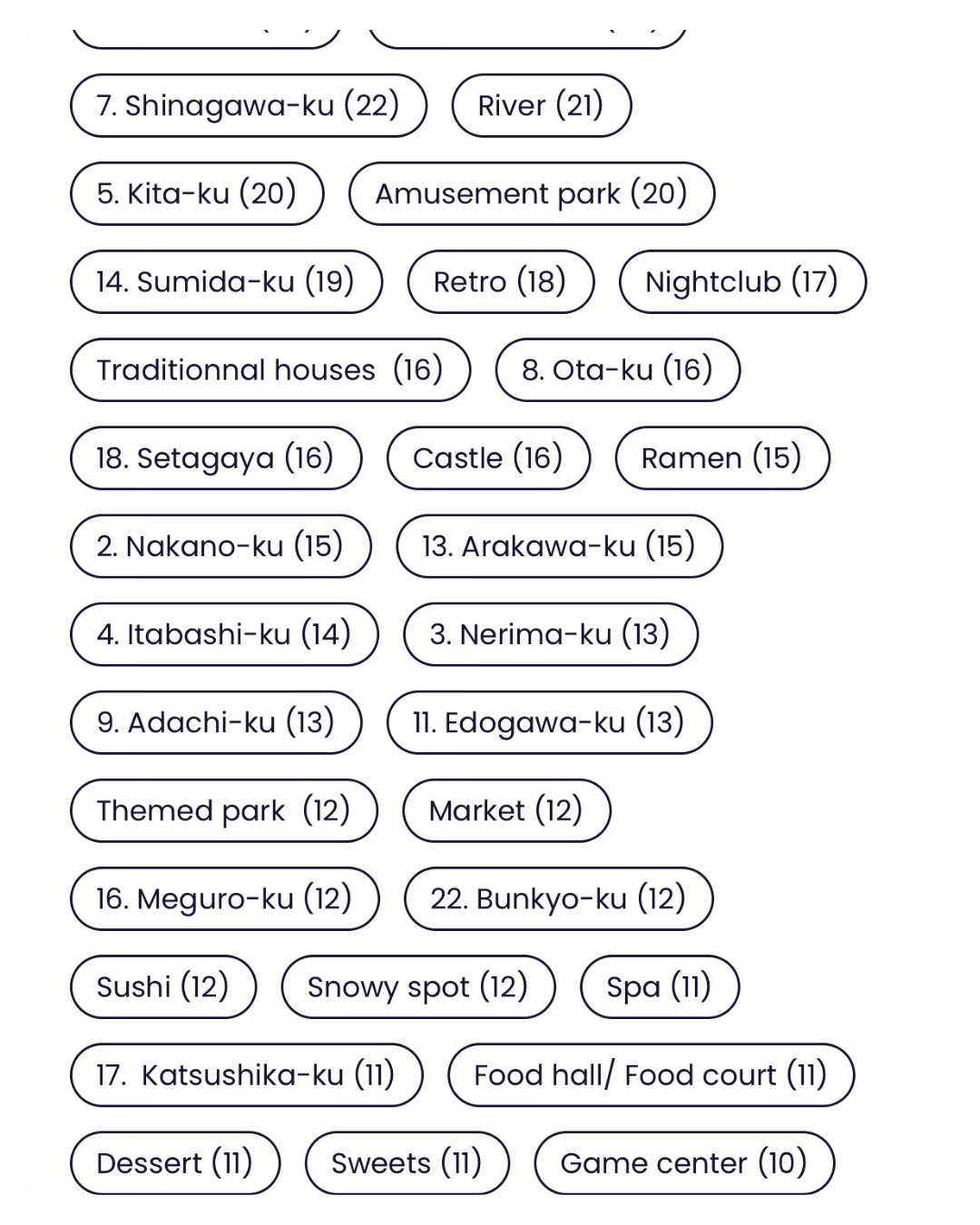


If you prefer something fully tailored, I also offer a 100% custom travel planning service.
I design a day-by-day itinerary based on your dates, interests, budget, travel pace, and priorities. You simply follow the plan and enjoy your trip.
And if you like flexible, editable itineraries, you can also find my ready-made itineraries on Holicay.
They’re ideal if you want a solid base you can customize with your travel companions.

Hi, I’m Marie, the creator behind @tabimawari.
I lived in Kyoto, learned Japanese, and keep returning to explore Japan beyond the obvious.
Planning a trip to Japan usually breaks at the same point: you save a lot of places, but don’t know how to turn them into a realistic route. Cities are large, distances are not intuitive, and it’s hard to know what actually fits in one day.
This guide was created to solve that. It helps you understand how places connect, how many days make sense per area, and how to build an itinerary that flows.
With the interactive map, you can explore curated spots across Japan, follow ready-made itineraries and day trips, mix my routes with your own, and adapt everything to your pace.

MY SOCIALS


MY NEWSLETTER
Japan Monthly by Tabimawari : Subscribe to get a monthly email packed with inspiration, local tips, and events happening across Japan straight from someone who’s lived and traveled a lot.
Look for the best accommodations in Japan :
Explore Japan with Local Guides
Marie creator behind @Tabimawari
Hi, I’m Marie.
French islander from Reunion island, Japan lover, and travel planner behind Tabimawari.
I spent a year living in Kyoto, learning Japanese and falling in love with the culture. Since then, I’ve kept going back, exploring every corner from Tokyo to the tiniest hidden towns.
I created these guides after spending months planning, testing, and fine-tuning every detail so you don’t have to. Inside, you’ll find:
✅ Interactive maps
✅ Step-by-step directions
✅ Local spots + travel tips
✅ Offline use
Each guide is made with care, based on real-life travel, not generic blog advice.
This is what I wish I had on my first trip to Japan and now it’s yours.
MY SOCIALS
MY NEWSLETTER
Plan your Japan trip without
the overwhelm
Follow me
Newsletter
Japan Monthly : Subscribe to get a monthly email packed with inspiration, local tips, and events happening across Japan straight from someone who’s lived and traveled a lot.